
Within the heart of the glass industry, end-port fired furnaces stand as critical assets for melting soda-lime-silica glass. Their efficient, horseshoe-shaped flame path enables high-volume production of container and flat glass. At the core of these furnaces‘ performance and longevity lies a critical, yet often overlooked, component: the refractory lining. These materials form the essential barrier against extreme temperatures (exceeding 1500°C), corrosive molten glass, and aggressive vapors. The systematic selection, application, and maintenance of refractories are not merely a matter of material science, but a decisive factor influencing furnace campaign life, product quality, energy efficiency, and overall operational economics. This article provides a comprehensive analysis of refractory strategies for end-port furnaces, exploring material properties, selection logic, and best practices for optimization.
Ⅲ. Systematic Selection Strategy and Key Engineering Practices
Ⅰ.Analysis of the Harsh Operating Conditions in End-Port Furnaces – The "Battlefield" for Refractories
To make informed refractory selections, a thorough understanding of the operational environment is essential. A conventional end-port fired furnace is structurally composed of several key zones: the melting end, refining (or fining) section, working end (or cooling zone), port necks (burners), regenerator chambers, and flue systems. Within this configuration, intricate heat transfer and mass exchange processes take place continuously between the combustion flame and the batch/glass materials.
1.1 The Sustained Challenge of High Temperature and Thermal Shock
The melting end is the hottest zone, with flame temperatures exceeding 1700°C and glass temperatures maintained at 1550-1600°C. Refractories here endure extreme temperatures long-term, requiring very high refractoriness and refractoriness-under-load. Simultaneously, furnace operation is not absolutely steady-state: periodic batch charging introduces "cold batch" impacts (especially at the doghouse), fluctuations in pull rate, and the periodic temperature changes caused by the reversal firing system (typically fluctuating within a 10-30°C range) all generate alternating thermal stresses within the refractories. This thermal shock resistance (spalling resistance) is a key indicator for refractories, particularly for superstructure materials.
1.2 The Complexity and Multi-Phase Nature of Chemical Attack
Chemical attack is the primary cause of refractory degradation, with complex mechanisms involving gas, liquid, and solid phases:
Direct Attack by Molten Glass: Molten silicate glass, especially soda-lime glass containing fluxes (Na₂O, K₂O, CaO, etc.), is a highly chemically active medium. It reacts with the main components of refractories (e.g., Al₂O₃, SiO₂, ZrO₂), forming new, often lower-viscosity liquid phases, leading to dissolution or penetration of the refractory and structural spalling. The attack rate is closely related to glass composition, temperature, flow velocity, and the refractory‘s microstructure.
Attack by Gaseous Volatiles: Alkali metals, boron, fluorine, chlorine compounds, etc., from the batch volatilize at high temperatures, travel with the flue gases, condense, and attack the furnace superstructure (e.g., crown, breastwalls, port mouths) and regenerator checker bricks. This attack often causes surface melting and powdering, commonly called "alkali scum" or "carryover."
Erosion and Reaction by Solid Particulates: Batch dust (rich in alkali and sulfates) carried by gas streams causes physical abrasion on refractory surfaces and may deposit and react, accelerating attack.
1.3 Mechanical Stress and Physical Wear
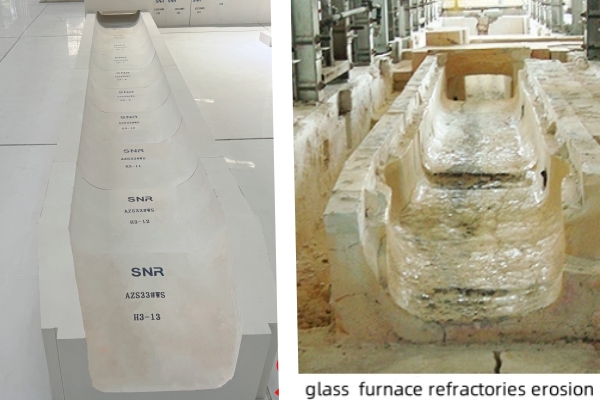
Complex convection currents exist within the molten glass in the tank, especially in the high-temperature melting zone, bubble or electric boosting areas, where faster flow rates cause continuouserosion on sidewall blocks. The mechanical push from batch chargers also impacts refractories in the doghouse area. Furthermore, the thermal expansion of the furnace structure itself and the differences in thermal expansion coefficients between different refractory materials generate significant internal mechanical stresses. Poor design or construction can easily lead to cracking, misalignment, or even collapse.
1.4 Differentiated Requirements by Functional Zone
The operating conditions vary drastically across different parts of an end-port furnace:
Melting End Sidewalls and Bottom: Face direct attack anderosion from high-temperature molten glass, experiencing the most severe erosion.
Refining End and Working End: Slightly lower temperatures, but require extremely high glass purity, demanding refractories with low contamination risk.
Crown (Roof): Withstands radiant heat, self-weight, and thermal stress, requiring very high hot strength and creep resistance.
Breastwalls, Port Necks: Endure flame radiation, gaseous volatile attack, and temperature fluctuations simultaneously.
Regenerator Checkerwork: Experiences harsh conditions—severe cyclic temperature changes (can surge from 300°C to over 1300°C) and intense chemical attack (condensation and reaction of alkali, sulfur, chlorine compounds). It is often a "weak link" and key to energy saving.
Doghouse (Batch Charger Area): Subject to combined action of thermal shock from cold batch, mechanical wear, and high-temperature attack.
Therefore, refractory selection must adhere to the fundamental principle of "functional zoning, precise matching"; no single material suits all locations.
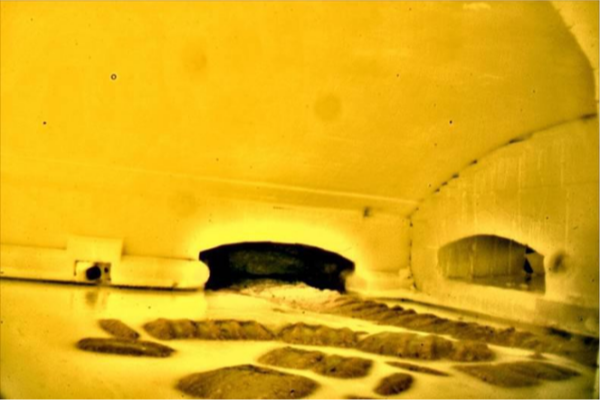

Facing diverse conditions, the glass industry has developed a range of refractories with distinct properties, mainly categorized into fused cast refractories and sintered refractories.
2.1 Fused Cast Refractories: The "Armor" for Sidewalls and Critical Areas
Fused cast refractories are produced by melting precisely batched raw materials in an electric arc furnace, casting into molds, followed by annealing and machining. They are dense, strong, and highly erosion-resistant, primarily used in high-wear areas in direct contact with molten glass.
Fused Cast AZS (Alumina-Zirconia-Silica) Blocks: The absolute mainstay for glass furnace sidewalls. Their main crystalline phases are corundum (α-Al₂O₃), baddeleyite (ZrO₂), and a glassy phase. The introduction of zirconia (ZrO₂) is key—it significantly enhances resistance to molten glass, especially basic soda-lime glass, and its unique phase transformation toughening effect improves thermal shock resistance. Common grades based on ZrO₂ content are 33# (~33% ZrO₂), 36# (~36% ZrO₂), and 41# (~41% ZrO₂). Typically, the highest erosion areas like melting end sidewalls (especially at the glass line), around bubblers, weirs, etc., prioritize higher ZrO₂ content 41# or 36# blocks, often using inclined or dense casting techniques to minimize shrinkage cavities, reducing the risk of glassy phase exudation and resulting seeds/stones.
Fused Cast α-β Alumina Blocks: Main crystalline phases are α-Al₂O₃ and β-Al₂O₃. Their greatest advantage is extremely low glassy phase content (<1%), causing minimal contamination to glass, rarely generating seeds or stones. However, their resistance to molten glass erosion, especially for high-alkali glass, is generally weaker than AZS. Thus, they are widely used in areas demanding high glass quality, such as refining end sidewalls, working end sidewalls, throat, riser, and forehearths. The β-Al₂O₃ phase offers good resistance to alkali vapor attack but is prone to hydration upon contact with water, requiring careful storage and installation.
Fused Cast Mullite Blocks, etc.: More limited application, mainly for specific glass compositions.

2.2 Sintered Refractories: The "Skeleton" and "Lining" of Furnace Structure
Sintered refractories are formed from powders and fired at high temperatures, offering flexible manufacturing and diverse shapes, usually at lower cost than fused cast blocks.
High-Quality Silica Bricks: The traditional choice for end-port furnace crowns. Their main component is SiO₂ (>94%), possessing a very high refractoriness-under-load (close to its refractoriness) and excellent creep resistance at high temperatures (>1450°C), able to withstand heat and self-weight long-term without significant sagging. Their critical weakness is poor thermal shock resistance, sensitivity to sudden temperature changes, requiring extreme caution during heat-up and daily operation. Their resistance to alkali vapor is also relatively weak.
Basic Refractories: The main force against gaseous alkali attack. Main types include:
Magnesia-Chrome Bricks: Historically widely used in upper checkerwork, port mouths, with strong resistance to alkali-sulfur attack. However, chromium pollution risk (formation and leaching of hexavalent chromium) has led to gradual replacement under environmental pressure.
Magnesia-Alumina Spinel Bricks: Representatives of environmentally friendly basic bricks. Through pre-synthesized or in-situ formed spinel, they offer good alkali resistance, thermal shock stability, and high-temperature strength. They are preferred materials for modern upper regenerator checkerwork, port mouths, and lower breastwalls.
Magnesia-Zirconia Bricks: Adding zirconia to magnesia-based materials further improves thermal shock stability and erosion resistance, an option for high-performance regenerator checker bricks.
High-Alumina and Mullite Refractories: Al₂O₃ content above 48%. They offer good high-temperature performance, thermal shock stability, and cost-effectiveness, widely used for furnace bottom paving blocks (often topped with a sintered AZS grain layer), working end sidewalls, backup lining behind insulation, various flues and arches. Among them, sintered AZS bricks (containing ZrO₂) are also commonly used in breastwalls, etc., as supplements or alternatives to fused cast AZS.
Zircon and Dense Zirconia Refractories: Primarily composed of ZrSiO₄ or ZrO₂, offering excellent resistance to molten glass and low contamination, often used for doghouse sidewalls, paving blocks, and contact areas for some special glasses.
Monolithic (Unshaped) Refractories and Insulating Materials:
Refractory Castables, Plastics, Ramming Mixes: Used for constructing complex shapes (e.g., port neck slopes, furnace bottom leveling layers, flue linings), hot repairs, and achieving monolithic sealing. They offer good integrity, no joints, and flexible installation.
Insulating Firebricks, Ceramic Fiber Products: Such as lightweight fireclay bricks, alumina hollow sphere bricks, alumino-silicate fiber modules. Applied on the furnace shell, they aim to minimize heat loss, crucial for reducing energy consumption. Note: Insulation must be applied only when the working lining is in good condition. Different grades of insulation should be selected for different temperature zones, and sealing must be ensured to prevent "cold bridges" and air leakage.
Ⅲ. Systematic Selection Strategy and Key Engineering Practices
3.1 Fundamental Principles and Decision-Making Process for Selection
Environment-Specific Material Matching
Each furnace zone has unique operational conditions—temperature ranges, exposure to corrosive media (molten glass, vapors, particulates), mechanical stresses, and thermal cycling intensity. Refractories must be selected to directly counter the dominant degradation mechanism in each specific location.
Priority on Glass Product Purity
In glass quality-critical sections like the refining zone and forehearth, the primary selection criterion is the material‘s ability to minimize defects. Options with inherently low contamination potential (e.g., α-β alumina blocks) are preferred, even when their absolute erosion resistance may be moderately lower than alternatives.
Comprehensive Lifecycle Cost Evaluation
Selection decisions should extend beyond initial purchase price to include total operational economics. This holistic view accounts for extended furnace campaign life, reduced maintenance frequency, minimized production downtime, and improved product yield—factors where high-performance refractories often deliver superior long-term value.
Integrated System Compatibility
The furnace operates as a cohesive unit, requiring careful coordination of all refractory components. Successful implementation depends on matching thermal expansion characteristics, ensuring chemical stability at material interfaces, and maintaining structural integrity throughout the entire lining system under operating conditions.
3.2 Material Recommendations and Precautions for Key Areas
Melting End Sidewalls (near glass line): Prioritize high-density, high ZrO₂ content (41#) fused cast AZS blocks. Block design favors large blocks, tilted blocks to reduce horizontal joints. Precautions: Strictly control joint thickness (≤1mm) using matching high-quality mortar; the glass line area erodes fastest—consider a "stepped" design for extra thickness or reserve backup thickness.
Crown: Traditionally, high-quality silica bricks are chosen. In modern designs, to pursue longer campaigns, sintered AZS arch bricks or high-performance sintered bricks like silliimanite-mullite are increasingly used, offering better thermal shock and alkali resistance. Precautions: Silica brick heat-up must strictly follow the prescribed curve, with sufficient soaking at critical phase transformation points like 573°C (β-quartz to α-quartz) and 870°C (quartz to tridymite); avoid severe temperature fluctuations during operation.
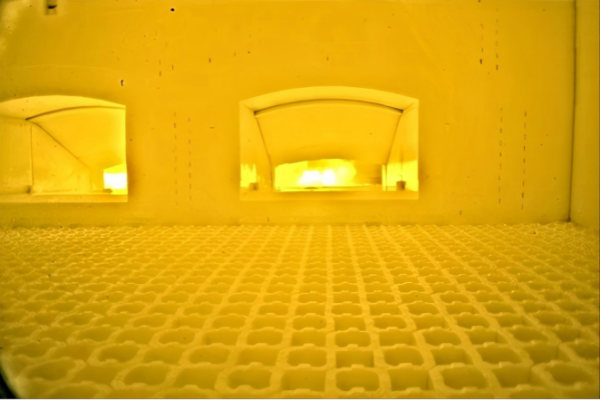
Upper Regenerator Checkerwork: A key area for technological upgrades. Direct-bonded magnesia-alumina spinel bricks or high-purity magnesia-zirconia bricks are recommended. Their resistance to alkali-sulfur attack, thermal shock, and clogging far exceeds traditional fireclay or ordinary magnesia-chrome bricks. Precautions: Checker brick shape design (e.g., cruciform, flue type) significantly impacts free-flow area, heat storage efficiency, and clogging resistance, requiring optimized selection; installation must be vertical and stable.
Doghouse: A zone of combined attack. Sidewalls can use dense zircon bricks or high-ZrO₂ AZS bricks; the bottom paving can use sintered AZS blocks or zircon ramming mixes. Precautions: The structure should consider designs to buffer batch pile impact; refractories need excellent thermal shock resistance.
Furnace Bottom Structure: Typically a multi-layer composite: the top layer is a sintered AZS ramming mix or sintered paving blocks isolating from molten glass; beneath is a penetration barrier layer (e.g., zircon or high-alumina ramming mix); followed by the load-bearing layer (e.g., large fireclay bricks or low-porosity fireclay bricks); and the bottommost is the insulation layer. Precautions: Bottom sealing is crucial to prevent glass leakage; special sealing and cooling around electrodes are needed for electric boost furnaces.
3.3 Fine Management of Installation, Heat-up, and Routine Maintenance
Precision Installation: "Three parts material, seven parts installation." Must use special refractory mortars matching the brick type; strictly control joint thickness and uniformity; position, size, and filling materials for expansion joints must follow design strictly; pre-assembly and numbering for critical areas.
Scientific Heat-up (Drying-out): The critical process to safely transition refractories from ambient to operating conditions. A detailed heating curve must be developed considering all refractory materials used (especially silica and basic bricks), with sufficient soaking periods at key temperatures like phase transformation points and moisture removal stages. Rushing the heat-up is a common cause of early refractory failure.
Intelligent Monitoring and Predictive Maintenance: Modern furnaces should be equipped with comprehensive thermal monitoring systems (infrared thermometers, thermocouples, cameras, etc.) to monitor temperatures and conditions of key areas (crown, sidewalls, regenerators) in real-time. Conduct regular furnace inspections (e.g., weekly), observing refractory color, erosion, cracks, hot spots, etc. Utilize short shutdowns for internal inspection and measurement, establish an erosion archive, predict remaining life, and develop scientific plans for hot repairs (e.g., gunning, patching, block insertion) and cold repair.
In conclusion, the selection and management of refractories in an end-port fired furnace represent a sophisticated balancing act between material capabilities, operational demands, and economic realities. There is no universal solution; success depends on a precise, zone-by-zone analysis and the strategic application of specialized materials like fused cast AZS blocks for severe wear areas and advanced basic bricks for vapor attack zones. By adhering to principles of scientific selection, precision installation, and proactive maintenance—while embracing trends towards longer life, monolithicity, and digitalization—operators can secure significant gains in furnace longevity, glass quality, and production cost-effectiveness. Ultimately, the continuous advancement of refractory technology remains a fundamental pillar for a more efficient, sustainable, and competitive glass industry.

Henan SNR Refractory Co., Ltd. has been specializing in the production of fused cast AZS blocks for more than 25 years. We use high-quality raw materials and advanced fusion and casting technology and equipment to provide customers with high-quality products. From raw material procurement to finished product delivery, every step is strictly quality inspected to ensure that every indicator meets the standards, so you can use it with confidence.
Should you have any inquiries or specific requirements, our team is ready to provide professional support and tailored solutions.
 Contact Information:
Web: www.snr-azs.com
Email:[email protected]


 +86-18203976036