

In the design and construction of glass furnaces, the selection of refractory materials directly impacts the furnace‘s operational lifespan, the quality of glass products, and the overall economic efficiency of the production cycle. Among the various refractory materials, fused cast AZS blocks—also known as fused cast zirconia-alumina-silica blocks—have become the most widely used critical materials in glass furnaces due to their excellent resistance to glass melt corrosion and superior high-temperature stability. Faced with the three common grades—33#, 36#, and 41#—available in the market, many procurement professionals and technical engineers often find themselves confused: What are the differences between them? Which grade should be used for the sidewall? What about the throat? Are the requirements for photovoltaic glass different from those for ordinary soda-lime glass? This article will address these questions and provide a clear, practical selection guide from three dimensions: furnace sections, glass types, and target furnace life.
1. Core Differences Between 33#, 36#, and 41# Fused Cast AZS Blocks
2. Selection by Furnace Section: Different Sections, Different Requirements
3. Selection by Glass Type: Different Glasses, Different Requirements
4. Selection by Target Furnace Life: Balancing Longevity and Cost
5. Common Selection Misconceptions and Considerations
1. Core Differences Between 33#, 36#, and 41# Fused Cast AZS Blocks
To make an informed selection, it is essential to understand the fundamental differences between the 33#, 36#, and 41# grades. The numbers in fused cast AZS block grades represent the mass percentage of zirconia (ZrO₂). Zirconia is the most critical component in fused cast AZS blocks for resisting corrosion; the higher the zirconia content, the stronger the block‘s resistance to glass melt attack.
33# blocks contain approximately 33% zirconia, making them the baseline in terms of corrosion resistance among the three grades.
36# blocks have a zirconia content of about 36%, offering significantly enhanced corrosion resistance.
41# blocks, with a zirconia content as high as 41%, provide the highest level of corrosion resistance while also having the lowest glass phase content. This means that under high-temperature operating conditions, 41# blocks exude less glass phase from the block matrix, posing a lower risk of contaminating the glass melt, and their structure is more dense and stable.
From a cost perspective, as the zirconia content increases, the production cost of the blocks also rises accordingly. Therefore, 33# blocks are typically the most economical, 36# blocks fall in the mid-range, and 41# blocks are the most expensive. However, it is important to emphasize that the selection decision should not be based solely on the unit price of the blocks. Instead, it should be evaluated from a lifecycle cost perspective—a 41# block may be significantly more expensive than a 36# block, but if it can extend the furnace life by one to two years, the resulting benefits will far outweigh the initial cost difference.
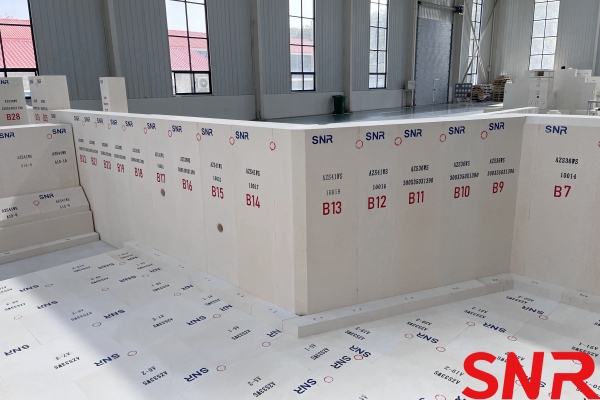

2. Selection by Furnace Section: Different Sections, Different Requirements
Different sections of a glass furnace face vastly different operating conditions, with varying corrosion mechanisms and risk levels. Therefore, the first step in selection is to determine the appropriate grade based on the risk level of each section.
In a glass furnace, the sidewall is the section most severely affected by corrosion, especially the area near the glass melt line. This zone simultaneously endures chemical corrosion from the glass melt, physical erosion from glass flow, thermal shock from temperature fluctuations, and alternating oxidizing and reducing atmospheres. It can be said that this is the harshest operating environment in the entire furnace. For sidewall selection, if the furnace design life is eight years or more, or if the furnace is melting highly corrosive glass types, the entire sidewall should be constructed with 41# blocks, with the melt line area absolutely requiring 41#. If the design life is between five and eight years, or if the corrosion risk is moderate, 41# blocks can be used for the melt line area, while 36# blocks can be used for the lower part of the sidewall. For short-life designs of three to five years or low-corrosion-risk applications, 36# blocks can be used throughout the sidewall, although the melt line area should still be reinforced appropriately.
The throat is the channel through which glass melt flows from the melting zone to the fining zone. In this area, the glass melt velocity is the highest, the temperature is the highest, and due to the small cross-section and concentrated flow, the throat is the most critical part of the entire furnace. Once the throat suffers severe corrosion or even penetration, it will directly lead to premature furnace shutdown, causing enormous economic losses. Therefore, there is no room for compromise in throat selection—41# blocks are mandatory, and it is recommended to use blocks produced with the void-free casting process to minimize internal casting defects. The cover block, side blocks, and bottom blocks of the throat must all be made of 41# blocks, leaving no room for downgrading.
The sill serves to block unmelted batch materials from entering the fining zone while also guiding the flow path of the glass melt. The sill is continuously submerged in the glass melt and subjected to direct erosion from glass flow, resulting in a relatively high corrosion risk. For sill selection, if the furnace design life is eight years or more, 41# blocks are recommended. If the design life is between five and eight years, 36# blocks can be used, but it is advisable to locally reinforce the top of the sill—the critical area in contact with the glass melt—with 41# blocks.
The doghouse area experiences mechanical impact from the batch materials, temperature fluctuations, and erosion from unmelted batch agglomerates. Although the erosion rate is not as fast as that at the sidewall melt line, the risk of thermal shock is higher. For doghouse selection, in oxy-fuel furnaces where flame temperatures are higher, 41# blocks are recommended. In air-fuel furnaces, 36# blocks can be used, but stress-concentrated areas such as the doghouse corners should be appropriately reinforced.
The bottom and superstructure sections face relatively lower corrosion risks. The bottom primarily undergoes static corrosion without significant glass flow erosion. The superstructure, such as the crown and breastwalls, does not come into contact with the glass melt and mainly withstands high temperatures and alkali vapor corrosion. For these sections, the bottom can be constructed with 33# or 36# blocks, depending on the furnace life requirements and glass type. The superstructure sections that do not contact the glass melt can use 33# blocks or even lower-grade sintered blocks. However, it should be noted that in oxy-fuel furnaces, alkali vapor concentrations are higher, so the selection for the superstructure should be appropriately upgraded.
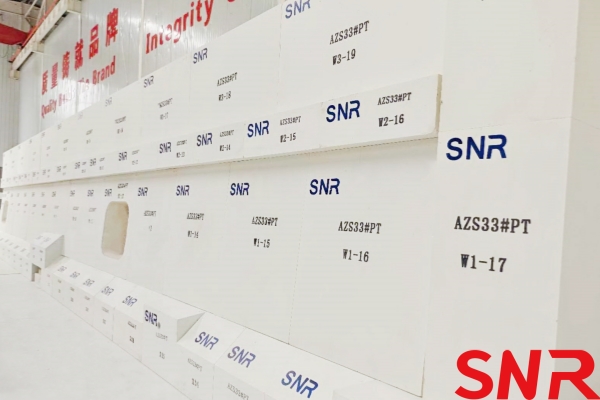
3. Selection by Glass Type: Different Glasses, Different Requirements
The type of glass determines the chemical composition, viscosity, surface tension, and melting temperature of the glass melt, all of which directly affect the corrosion rate of fused cast AZS blocks. Therefore, the second step in selection is to adjust the material standards based on the glass type.
Photovoltaic glass, also known as ultra-clear patterned glass, has extremely strict requirements for stones and bubbles. Even the smallest defects can reduce the efficiency of solar cells. Photovoltaic glass has a relatively high melting temperature, typically around 1600°C, and the glass melt has low viscosity and strong erosive capability, making it particularly sensitive to zirconia-based stones. Therefore, in photovoltaic glass furnaces, the sidewall, throat, and sill must all be constructed with 41# blocks, and products with low glass phase exudation are required. 33# blocks are strictly prohibited in critical sections because their higher glass phase content increases the risk of exudation. Additionally, it is recommended to use fused cast AZS blocks produced by the oxidation melting process to further reduce the glass phase content and minimize the risk of contaminating the glass melt.
High-alumina glass, mainly used in cover glass and smartphone screens, is characterized by its high alumina content and high melting temperature, typically exceeding 1650°C. High-alumina glass melt corrodes fused cast AZS blocks at a significantly faster rate than ordinary soda-lime glass, imposing higher demands on refractory materials. In high-alumina glass furnaces, the sidewall, throat, and sill must all be constructed with 41# blocks, and void-free 41# blocks are recommended to minimize defects. Due to the fast corrosion rate, the design life of high-alumina glass furnaces is typically no more than five years, after which a comprehensive assessment of the remaining block life is
required.

Pharmaceutical glass, primarily borosilicate glass, demands extremely high hydrolytic resistance and chemical stability, with no allowance for refractory material exudates to contaminate the glass melt. Borosilicate glass also has a high melting temperature, around 1650°C, and the boron oxide in the glass melt interacts with fused cast AZS blocks differently than soda-lime glass does. In pharmaceutical glass furnaces, critical sections require 41# blocks with extremely low glass phase exudation. Some high-end pharmaceutical glass furnaces even use high-zirconia blocks instead of fused cast AZS blocks in the sidewall, though this significantly increases costs. For pharmaceutical glass furnaces, it is recommended to conduct corrosion compatibility tests with refractory suppliers to ensure the selected material solution meets the stringent quality requirements.
Soda-lime glass is the most common glass type, widely used in flat glass and container glass applications. Soda-lime glass has a relatively low melting temperature, around 1550°C, and is less corrosive to refractory materials, with higher cost sensitivity. For soda-lime glass furnaces, if the design life is eight years or more, the sidewall melt line area should be constructed with 41# blocks, while other sections can use 36# blocks. If the design life is between five and eight years, critical sections can use 36# blocks, and general sections can use 33# blocks. If the design life is between three and five years, 33# blocks can be used throughout, although the throat should still be appropriately upgraded.
4. Selection by Target Furnace Life: Balancing Longevity and Cost
Target furnace life is the ultimate consideration in the selection decision. Different design lives correspond to different material selection strategies, requiring a balance between longevity and cost.
For long-life furnaces with a design life of eight years or more, the goal is to maximize the operational cycle and ensure stable production. Under this strategy, the sidewall melt line area should be constructed with 41# blocks, the lower sidewall also with 41# blocks, the throat must use 41# blocks, the sill should use 41# blocks, the doghouse should use 41# blocks, the bottom can use 36# blocks, and the superstructure can use 36# blocks. Although this solution involves a higher initial investment, it provides the greatest assurance of long-term stable furnace operation.
For medium-life furnaces with a design life of five to eight years, the goal is to balance performance and cost. Under this strategy, the sidewall melt line area uses 41# blocks, the lower sidewall can use 36# blocks, the throat must use 41# blocks, the sill can use 36# blocks, the doghouse can use 36# blocks, the bottom can use 36# blocks, and the superstructure can use 33# blocks. This solution ensures the safety of critical sections while moderately controlling costs.
For short-life furnaces with a design life of three to five years, cost control often becomes an important consideration. Under this strategy, the sidewall melt line area can use 36# blocks, the lower sidewall also uses 36# blocks, the throat can use 36# blocks, the sill can use 33# blocks, the doghouse can use 33# blocks, the bottom can use 33# blocks, and the superstructure can use 33# blocks. However, it is important to note that even in short-life designs, if the furnace is melting high-corrosion-risk glass types such as photovoltaic glass, high-alumina glass, or pharmaceutical glass, the selection standards still need to be correspondingly upgraded.
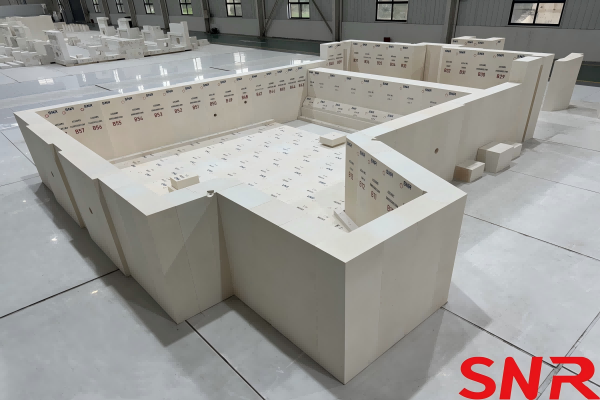
In the actual selection process, there are several common misconceptions worth noting.
One common misconception is that a single grade can be used for all sections to simplify procurement and management. While this approach may seem convenient, it is not scientifically sound. If 36# blocks are used uniformly throughout the furnace, the sidewall melt line and throat may face insufficient corrosion resistance, while the bottom and superstructure may experience performance overkill, resulting in unnecessary cost waste. The correct approach is to select grades based on the risk level of each section, allocating budget where it matters most.
Another common misconception is the excessive pursuit of cost reduction by opting for lower-grade materials—such as using 33# AZS blocks for critical areas like the throat and sidewall melt line. This approach is extremely risky and can shorten furnace life by 30–50%. The economic losses caused by premature shutdown far outweigh any initial savings on block materials. In critical sections, there should be no compromise on quality.
Another common misconception is ignoring the unique characteristics of different glass types. For example, the selection criteria for soda-lime glass furnaces are directly applied to photovoltaic glass furnaces. The high sensitivity of photovoltaic glass to pebbles can cause zirconia-based pebbles to seep out of glass #33 block, resulting in widespread product defects. Therefore, selection criteria must be adjusted according to the glass type, and for high-risk glass types, all processes need to be upgraded.
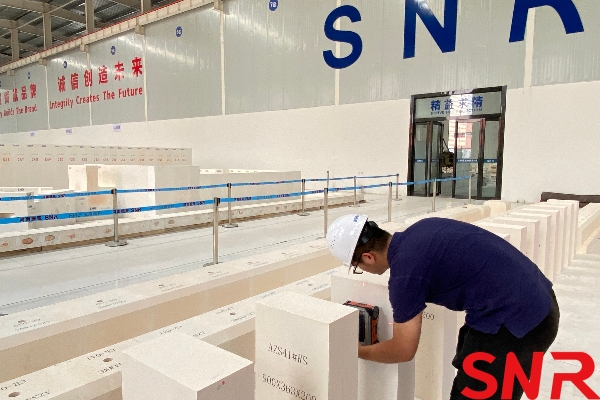
The selection of 33#, 36#, and 41# fused cast AZS blocks is fundamentally a process of balancing risk and cost. There is no one-size-fits-all solution—only customized strategies based on specific furnace conditions.
Critical sections—such as the sidewall melt line and throat—face the highest corrosion risk and should be prioritized with the highest-grade materials.
Glass type determines baseline selection criteria. High-risk categories, including photovoltaic, high-alumina, and pharmaceutical glass, require comprehensive material upgrades.
Target furnace life guides the final balance point. Long-life furnaces demand high-grade assurance, while short-life furnaces may allow for moderate optimization.
Material selection decisions shouldn‘t be based solely on unit price; the entire lifecycle must be considered. The initial investment for a #41 block might be higher than for a #36 block, but extending the furnace‘s lifespan by one to two years will yield overall benefits far exceeding the initial cost difference.
Therefore, whether you‘re building a new furnace or performing a cold repair, we strongly recommend consulting with a professional technical team to develop the optimal material selection plan, taking into account furnace parameters, glass type, and target furnace lifespan.
[ SNR - Casting the Solid Backbone of Glass Furnaces]
 Any demands for high quality fused cast AZS blocks, please feel free to contact us!
Contact Information:
Web: www.snr-azs.com


 +86-18203976036