

Sidewall heat loss represents one of the largest sources of thermal inefficiency in glass melting furnaces. While fused cast AZS (Alumina-Zirconia-Silica) blocks have long been the industry standard for sidewall construction, traditional designs treat these refractories solely as corrosion barriers rather than integral components of the furnace thermal management system. This article examines common misconceptions surrounding AZS sidewall insulation and presents engineering best practices based on composite insulation technology. Drawing from research on low-thermal-conductivity AZS composite blocks and field applications across multiple glass furnace installations, we demonstrate how proper composite insulation design can significantly reduce heat loss while maintaining structural integrity and corrosion resistance.
1. Introduction: The Scale of the Problem
2. Understanding AZS Material Properties
3. Common Design Myths and Their Origins
4. Best Practices for AZS Composite Insulation
1. Introduction: The Scale of the Problem
Glass melting furnaces operate at temperatures between 1570°C and 1610°C, with energy costs representing a substantial portion of production expenses. Among all heat loss pathways, sidewall radiation and conduction account for 15-25% of total thermal output in conventionally designed furnaces. The fundamental challenge lies in a persistent industry misconception: that insulating the sidewall inevitably accelerates AZS block corrosion.
This fear, while rooted in legitimate concerns about glass phase exudation (commonly referred to as "sweating" or "bleeding"), has led many furnace designers to adopt overly conservative approaches—either omitting insulation entirely or using insufficient layers that fail to capture meaningful energy savings. The result is a "heat leak tiger" that continuously drains furnace efficiency.
Recent developments in composite AZS technology offer a path forward. By integrating dense, corrosion-resistant AZS working surfaces with lightweight, low-conductivity backing materials, manufacturers have created a new class of refractory that addresses both durability and insulation requirements simultaneously.
2. Understanding AZS Material Properties
2.1 Composition and Structure
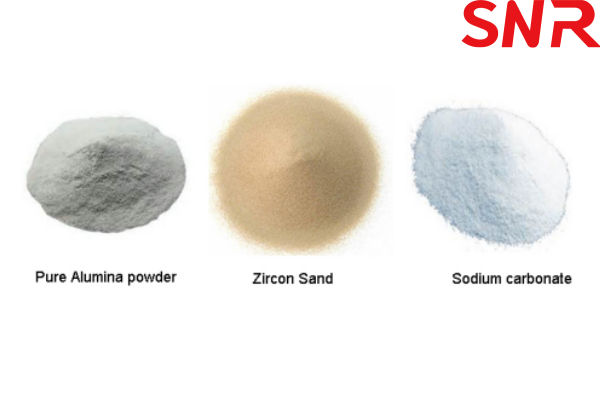
Fused cast AZS refractories are produced by melting a mixture of alumina (Al₂O₃), zirconia (ZrO₂), and silica (SiO₂) at temperatures exceeding 2000°C, then casting the molten material into molds. The resulting microstructure consists of three primary crystalline phases:
Corundum (α-Al₂O₃): Provides mechanical strength and corrosion resistance
Baddeleyite (ZrO₂): Enhances resistance to molten glass attack and improves thermal shock tolerance
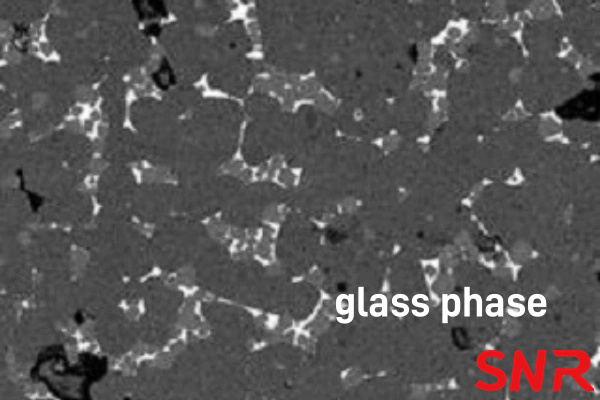
Glass phase (silicate matrix): Binds crystalline components but is also the source of thermal conductivity and potential exudation issues
Commercial grades are classified by zirconia content: AZS-33 (33% ZrO₂), AZS-36 (36% ZrO₂), and AZS-41 (41% ZrO₂). Higher zirconia content correlates with improved corrosion resistance but also increases material cost and affects casting behavior.
2.2 Thermal Conductivity Characteristics
Standard fused cast AZS blocks exhibit relatively high thermal conductivity compared to other refractory types. Typical values range from 3.5 to 4.5 watts per meter-Kelvin at 1000°C. For context, this is roughly comparable to carbon steel and significantly higher than insulating firebrick (0.3 to 0.8 W/(m·K)) or ceramic fiber (0.1 to 0.2 W/(m·K)).
This high thermal conductivity means that without adequate insulation, heat readily conducts through the sidewall and radiates to the surrounding environment. The problem is exacerbated by the thick sections required for structural integrity and corrosion allowance. A typical sidewall uses AZS blocks 200 to 300 millimeters thick. This thickness provides a long service life by allowing the hot face to gradually erode over time while maintaining structural integrity. However, it also provides a large cross-section for heat conduction.
2.3 The Glass Phase and the Exudation Risk
The glass phase that binds AZS crystalline components softens at elevated temperatures. The softening point varies with composition but typically begins above 1100°C and becomes pronounced above 1200°C. When the glass phase softens, it becomes mobile and can migrate toward cooler surfaces under the influence of thermal gradients.
Under certain conditions—particularly when insulation is applied without understanding block orientation and thermal gradients—this glass phase can migrate through the interconnected porosity and exude from the block face. This "sweating" or "bleeding" creates several problems. First, the loss of glass phase leaves voids within the block structure, increasing porosity and reducing mechanical strength. Second, the exuded glass can react with adjacent materials or drip onto furnace components. Third, the altered block composition becomes more susceptible to chemical attack from molten glass.
However, it is critical to note a nuance that many industry myths have unfortunately obscured: properly designed composite insulation does not cause glass phase exudation. The risk arises only under specific combinations of conditions, including the use of standard-cast (not void-free) blocks, incorrect block orientation, excessively thick insulation that raises the temperature of the cold face, or rapid thermal cycling. Each of these risk factors can be managed through proper design and installation practices.
3. Common Design Myths and Their Origins
Three persistent myths have discouraged the adoption of effective sidewall insulation. Understanding the origin of each myth is essential to overcoming industry resistance.
Myth #1: "Any insulation on AZS sidewalls causes glass phase exudation"
The origin of this myth lies in early attempts at sidewall insulation during the 1970s and 1980s. In that era, many furnace designers experimented with applying blanket insulation or castable insulation directly to the cold face of standard AZS blocks. In some cases, this did indeed lead to exudation problems. However, the failures occurred under specific conditions that are now well understood.
The critical factor is not the presence of insulation but rather the temperature of the glass phase within the block. When insulation is applied to a standard-cast (non-WS) block with shrinkage cavities oriented toward the hot face, and when the insulation thickness is sufficient to raise the entire block temperature above the glass phase softening point, exudation becomes likely. When insulation is properly engineered—using void-free (WS or ZWS) casting, correct block orientation (casting sprue facing outward), appropriate insulation thickness, and gradual thermal cycling—exudation can be prevented while achieving significant energy savings.
Field evidence supports this conclusion. Multiple glass furnaces have operated for years with properly designed composite sidewall insulation without any reported exudation issues. The key is to match the insulation design to the specific block grade and installation method.
Myth #2: "Thicker insulation always yields better results"
Basic heat transfer principles suggest that adding insulation reduces heat loss. However, in refractory systems, there are diminishing returns and potential risks. The relationship between insulation thickness and heat loss is nonlinear. Doubling insulation thickness from 25 to 50 millimeters reduces heat loss by approximately 40%. Doubling again from 50 to 100 millimeters reduces heat loss by only an additional 20%. Beyond 100 millimeters, the incremental benefit becomes very small.
More importantly, excessive insulation thickness raises the temperature of the cold face of the AZS block. If this temperature exceeds approximately 250°C to 300°C (depending on the specific block composition and casting method), the glass phase within the block may become sufficiently mobile to cause exudation problems. The goal is to achieve a balanced thermal gradient that keeps the glass phase within the block at temperatures below its exudation threshold while minimizing heat loss to the environment. For most AZS grades and furnace conditions, the optimal insulation thickness ranges from 50 to 100 millimeters of high-performance insulating refractory.

Myth #3: "Composite blocks are unproven and risk furnace life"
The refractory industry has historically been conservative. Furnace operators understandably prioritize reliability over efficiency gains, because an unplanned furnace shutdown costs millions of dollars in lost production and repair expenses. New product introductions require extensive validation before they gain industry acceptance.
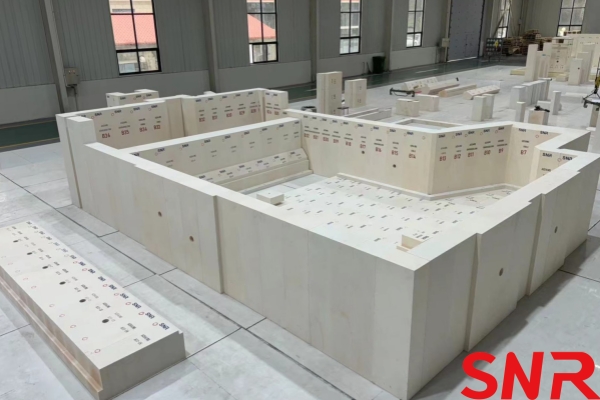
However, the assertion that composite blocks are unproven is no longer accurate. Low-thermal-conductivity composite AZS blocks have been successfully installed in multiple commercial furnaces across different glass sectors. Documented installations include pharmaceutical glass furnaces (30 ton per day, Chengdu Nipro, operating for more than three years without exudation), float glass lines (500 ton per day, Sichuan Glass, operating for more than four years with equivalent corrosion resistance to conventional blocks), and flat glass furnaces (500 ton per day, Qingdao Jinjian, operating for more than three years with 8% reduction in fuel consumption).
Field performance data from these installations demonstrate that composite blocks achieve equivalent or superior service life compared to conventional block-plus-insulation systems. The integrated construction eliminates the air gaps that can occur in field-assembled systems, reducing thermal stresses and improving structural stability.
4. Best Practices for AZS Composite Insulation
Based on the analysis of material properties and the debunking of common myths, this section presents engineering best practices for AZS sidewall composite insulation.
4.1 The Composite Block Approach
The most reliable method for achieving sidewall insulation is the use of integrally cast composite blocks. The manufacturing process involves several carefully controlled steps. First, a shaped AZS block is cast with a recessed cavity or groove on the non-working face. This cavity is designed to accommodate high-performance insulation material. Second, the insulation material—typically lightweight mullite or alumina-based refractory with a density of 1.2 to 1.8 g/cm³ and thermal conductivity of 0.5 to 0.8 W/(m·K) at 1000°C—is placed into the cavity. Third, the entire assembly undergoes controlled cooling and annealing to minimize residual stresses.
This approach offers several advantages over field-assembled insulation systems. The elimination of air gaps between the AZS and insulation layers improves heat transfer consistency and reduces the risk of localized hot spots. Reduced installation labor and quality variability lower overall project costs. Improved structural stability under thermal cycling extends service life. Lower overall density—composite blocks achieve bulk densities of ≤3.45 g/cm³ compared to 3.7 to 3.9 g/cm³ for solid AZS—reduces structural loading on the furnace support steel.
4.2 Material Specifications
For composite sidewall applications, the following material properties are recommended based on proven field performance. The dense AZS layer should contain at least 32.5% ZrO₂ (AZS-33 or higher grade). Apparent porosity must be ≤2% to minimize glass penetration. Void-free (WS) or near-void-free (ZWS) casting is strongly preferred over standard (PT) casting for insulated applications. Thermal conductivity at 1000°C should be ≤3.5 W/(m·K) for the dense layer.
The overall composite block should achieve a bulk density ≤3.45 g/cm³. The insulation layer should have a refractoriness suitable for service temperatures up to 1400°C to 1500°C at the interface with the AZS layer. Corrosion resistance must be maintained at ≤1.5 millimeters per 24 hours under standard test conditions.
4.3 Installation Guidelines
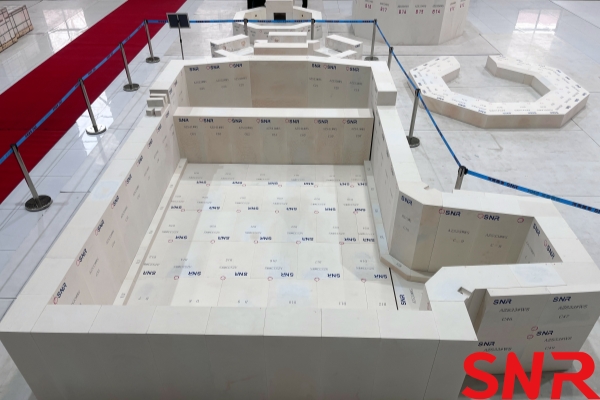
Expansion joint management requires careful attention. Appropriate expansion gaps must be left between the sidewall and breast wall—typically 25 to 35 millimeters depending on furnace size and expected thermal expansion. Similarly, gaps of approximately 20 millimeters should be provided between the crown and sidewall. These gaps accommodate thermal expansion without inducing stress cracking that could propagate through the block.
The heat-up protocol is particularly important for AZS refractories. During initial furnace heating, the critical temperature range for AZS is 1200°C to 1350°C at the crown, which corresponds to 1100°C to 1250°C at the sidewall. Within this range, the monoclinic-to-tetragonal phase transformation of zirconia produces a volume change of approximately 3% to 5%. Heating rates must be controlled to no more than 2.8°C per hour within this range to allow the block structure to accommodate this transformation without cracking. Total heat-up time for a typical furnace with AZS sidewalls is 15 to 25 days, depending on furnace size and block mass.
4.4 Multi-Layer Wall Systems
For maximum efficiency, a complete sidewall insulation system may incorporate multiple layers:
|
Layer |
Material |
Function |
|
1 |
AZS composite block (dense face) |
Corrosion resistance, glass contact |
|
2 |
Zirconia-based ramming mix |
Thermal barrier, gap filling |
|
3 |
Mullite insulating brick |
Structural insulation |
|
4 |
Ceramic fiber blanket (optional) |
Supplemental insulation |
This layered approach provides a total thermal resistance that can reduce outer wall temperatures from 300-400°C (with uninsulated AZS) to 80-120°C—a reduction in heat flux of approximately 2,000-3,000 W/m².
5. Performance Validation
5.1 Laboratory Results
Research conducted by China Building Materials Academy on low-thermal-conductivity AZS composite blocks has been published in the proceedings of the 2013 National Glass Furnace Technology Symposium. The key findings include an 18% to 22% reduction in thermal conductivity compared to standard AZS-33 blocks. Corrosion resistance was maintained at static corrosion rates ≤1.5 millimeters per 24 hours, equivalent to conventional blocks. Thermal shock resistance improved due to reduced thermal gradients within the block, which lowers thermal stresses during furnace cycling.
5.2 Field Installations
Composite AZS blocks have been successfully applied in multiple commercial glass furnaces. Table 1 summarizes the documented installations.
|
Installation |
FurnaceType |
Capacity |
Service Duration |
Reported Results |
|
Chengdu |
Pharmaceutical glass |
30 t/day |
>3 years |
No exudation; 25% reduction in sidewall temperature |
|
Sichuan |
Float glass |
500 t/day |
>4 years |
Equivalent corrosion resistance; 30% lower heat loss |
|
Qingdao |
Flat glass |
500 t/day |
>3 years |
8% reduction in fuel consumption |
These field results confirm that composite AZS blocks perform as intended under real operating conditions. No exudation, spalling, or premature failure has been reported from these installations.
6. Conclusion
The fear that sidewall insulation inevitably damages AZS refractories is a myth that has cost the glass industry millions in unnecessary energy waste. Modern composite AZS technology—combining dense, corrosion-resistant working surfaces with integrally cast insulation layers—offers a proven solution that delivers:
Reduced heat loss (25-35% compared to uninsulated designs)
Maintained or improved service life (no accelerated corrosion when properly specified and installed)
Lower installation costs compared to field-assembled multi-layer systems
Demonstrated field performance across multiple furnace types and glass compositions
For furnace designers and operators seeking to improve energy efficiency, the question is no longer "should we insulate AZS sidewalls?" but rather "which composite solution best fits our specific operating conditions?"
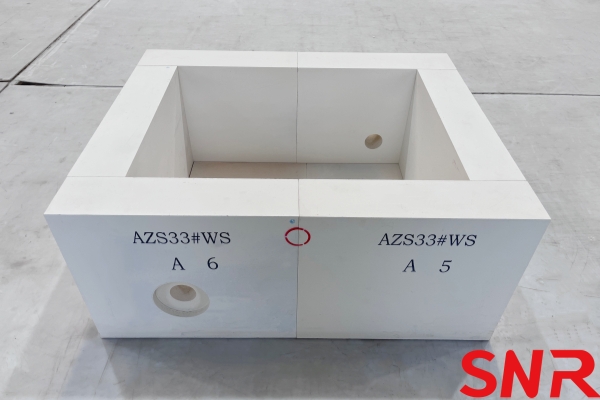
Henan SNR Refractory Co., Ltd. has been specializing in the production of fused cast AZS blocks for more than 25 years. We use high-quality raw materials and advanced fusion and casting technology and equipment to provide customers with high-quality products. From raw material procurement to finished product delivery, every step is strictly quality inspected to ensure that every indicator meets the standards, so you can use it with confidence.
Should you have any inquiries or specific requirements, our team is ready to provide professional support and tailored solutions.
 Contact Information:
Web: www.snr-azs.com
Email:[email protected]


 +86-18203976036