

Introduction
Glass manufacturing is one of the oldest and most technologically demanding industrial processes in the world. From architectural glass and container glass to photovoltaic glass and electronic display glass, modern society relies heavily on stable, efficient, and high-quality glass production systems. At the heart of every glass production line lies the glass melting glass furnace, a complex high-temperature system designed to continuously transform raw materials into homogeneous molten glass.
The performance and lifespan of a glass furnace are largely determined by the quality of its refractory materials. Among various refractory products, fused cast refractories play an irreplaceable role due to their excellent resistance to glass corrosion, high-temperature stability, and mechanical strength. These materials are widely used in critical glass furnace areas such as sidewalls, throat sections, charging zones, and superstructures.
As glass technology evolves toward larger glass furnace capacities, cleaner production, and higher product quality, the demands placed on refractory materials continue to increase. This article explores the structure and operation of modern glass furnaces, the properties and classifications of fused cast refractories, their applications in different glass furnace zones, and the future development trends of refractory technology in the glass industry.
1. Basic Structure and Working Principle of glass furnaces
glass furnaces are continuous high-temperature industrial units designed to melt, refine, homogenize, and distribute molten glass. Depending on the glass type and production scale, glass furnace designs may vary significantly. However, most modern glass furnaces share several common structural sections.
1.1 Charging Zone
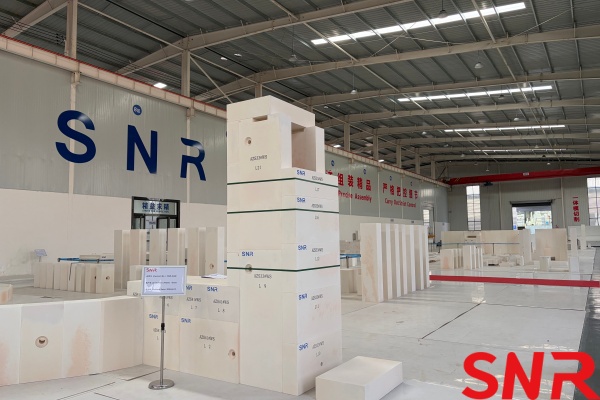
The charging zone is where raw materials such as silica sand, soda ash, limestone, dolomite, feldspar, and cullet are introduced into the glass furnace. This area experiences severe thermal shock due to the continuous contact between cold batch materials and the high-temperature environment.
The refractory materials used in this area must possess excellent thermal shock resistance and resistance to chemical attack from alkali vapors and batch materials. In large-scale glass furnaces, fused cast AZS blocks with enhanced thermal shock performance are often preferred to prevent cracking during batch coverage and uncovering cycles.
1.2 Melting Zone
The melting zone is the core section of the glass furnace where raw materials are transformed into molten glass. Temperatures in this area typically range from 1450°C to 1600°C depending on the glass composition and melting technology.
This zone is subjected to intense glass corrosion, high thermal loads, and flame erosion. Fused cast AZS refractories are widely used in this section because of their exceptional corrosion resistance and structural integrity.
In a modern float glass furnace with a daily production capacity of 800 tons, the sidewall temperature near the melting zone can remain above 1500°C for years without interruption. Under such harsh conditions, ordinary sintered refractories would rapidly suffer from glass penetration, structural cracking, and severe erosion.
Fused cast AZS blocks, however, form a dense and highly corrosion-resistant structure during the electrofusion process. Their glassy phase can effectively reduce the penetration speed of molten glass, while the zirconia-rich crystal structure improves resistance to alkali attack and high-temperature wear.
For example, in photovoltaic glass furnaces operating with high pulling speeds, molten glass circulation becomes more aggressive than in traditional container glass furnaces. In these cases, many glass furnace designers prefer AZS-41 blocks in critical sidewall sections because of their higher zirconia content and improved resistance to flowing glass corrosion.
Another important factor in the melting zone is glass furnace atmosphere stability. Poor combustion adjustment may create local overheating or reducing atmospheres, which can accelerate refractory damage. Reducing conditions, in particular, can decompose the glassy phase in AZS materials, leading to accelerated corrosion and blister formation in the glass. Therefore, modern glass furnace control systems continuously monitor flame distribution, glass furnace pressure, and crown temperature to protect refractory structures.
1.3 Refining Zone
In the refining zone, gas bubbles trapped in the molten glass are removed to improve glass quality. The temperature is carefully controlled to optimize glass viscosity and bubble release. Typically, the refining zone operates at slightly higher temperatures than the melting zone to reduce viscosity and allow bubbles to rise.
Refractories in this zone must maintain dimensional stability and resist long-term corrosion under stable but aggressive operating conditions. Fused cast AZS-33 and AZS-36 blocks are commonly used here, as they provide sufficient corrosion resistance while being more cost-effective than higher-zirconia grades.
1.4 Working End and Forehearth
After refining, molten glass flows into the working end and forehearth, where the temperature is gradually reduced before forming. Stable thermal conditions are essential to ensure consistent glass quality.
Refractory materials used in these areas must minimize contamination and avoid defects such as stones, blisters, or cords in the final glass products. Fused cast alumina or high-purity zirconia materials are often selected for high-quality glass lines, as they have very low tendency to exsolve glassy phases or release bubbles into the molten glass.
2. Types and Characteristics of Fused Cast Refractories
Fused cast refractories are manufactured by melting selected raw materials in an electric arc glass furnace at extremely high temperatures, typically above 2000°C, and then casting the molten material into molds. After casting, the blocks undergo a controlled annealing process to relieve internal stresses and achieve the desired crystal structure. Compared with traditional sintered refractories, fused cast products have a denser structure, lower porosity, and superior corrosion resistance.
2.1 Fused Cast AZS Refractories
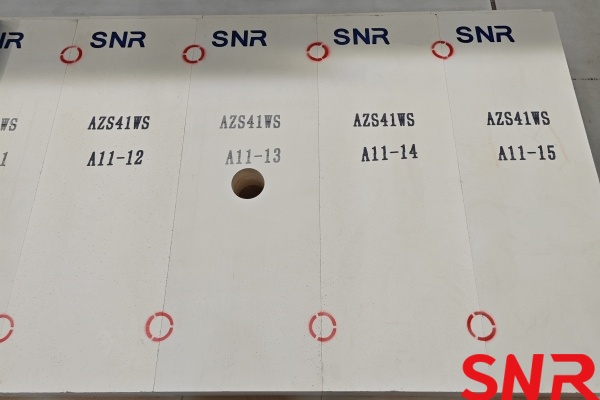
AZS stands for alumina-zirconia-silica. It is the most commonly used fused cast refractory in glass furnaces. According to zirconia content, AZS products are generally classified as AZS-33, AZS-36, and AZS-41.
AZS-33 contains approximately 33% zirconia and offers balanced performance in terms of cost and corrosion resistance. It is commonly used in less aggressive glass furnace areas such as upper sidewalls, lower-wear zones, and refining sections. Its microstructure consists of a fine interlocking network of baddeleyite (ZrO₂) and corundum (Al₂O₃) embedded in a silica-rich glassy phase.
AZS-36 has improved corrosion resistance due to its higher zirconia content and more optimized microstructure. It is often used in sidewalls, throat sections, and areas with higher glass flow velocity. The denser structure of AZS-36 provides better protection against glass penetration and is particularly effective in glass furnaces producing soda-lime glass.
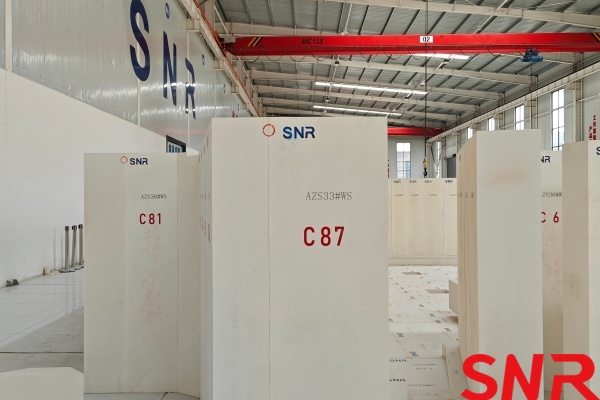
AZS-41 contains the highest zirconia content among standard AZS products, typically 41% by weight, and demonstrates excellent resistance to severe glass corrosion. It is widely applied in high-wear glass furnace zones such as the melting zone sidewalls, throat entrances, and doghouse corners. The increased zirconia content also improves resistance to alkali vapor attack, making AZS-41 suitable for oxy-fuel glass furnaces where alkali concentrations are higher.
2.2 Fused Cast Alumina Refractories
Fused cast alumina refractories are mainly composed of alpha-alumina crystals. They exhibit excellent resistance to alkali vapor attack and high-temperature erosion. Unlike AZS materials, alumina refractories do not contain zirconia and therefore have a different corrosion mechanism. They are particularly resistant to alkali sulfate attack, which can occur in superstructure areas where sulfate-containing batch materials condense.
These products are often used in glass furnace crowns, upper structures, and electric boosting areas. In oxy-fuel glass furnaces, fused cast alumina crowns are increasingly replacing traditional silica crowns because of their superior resistance to alkali vapor corrosion at higher operating temperatures.
2.3 Fused Cast Zirconia Refractories
Fused cast zirconia refractories provide extremely high corrosion resistance and minimal glass contamination. Their microstructure is almost entirely composed of stabilized cubic zirconia, which is chemically inert in most glass compositions. However, their high cost limits their use to special applications such as ultra-clear glass, high-end electronic glass furnaces, and glass fiber production lines where even trace contamination cannot be tolerated.
3. Application of Fused Cast Refractories in glass furnaces
The selection of refractory materials for each glass furnace area directly affects glass furnace lifespan, production efficiency, energy consumption, and glass quality.
3.1 Sidewalls
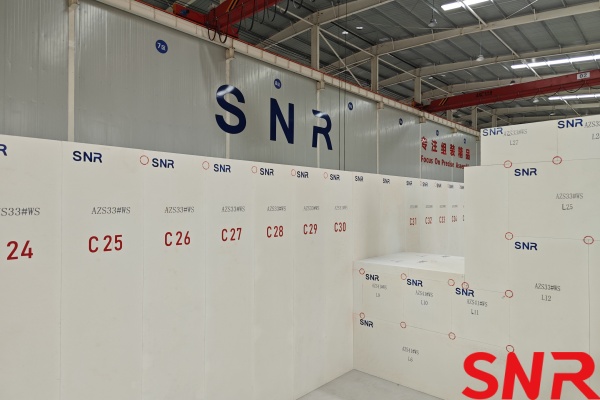
The sidewalls are continuously exposed to molten glass and experience one of the highest corrosion rates in the glass furnace. Fused cast AZS blocks are considered the industry standard for sidewall applications. The dense microstructure of AZS materials effectively slows down glass penetration and erosion. High-zirconia grades such as AZS-41 are commonly used in areas with strong glass circulation, such as near the melting zone end and at the throat entrance.
Sidewall design has evolved significantly in recent decades. Modern glass furnaces often use bonded sidewall blocks, where multiple AZS blocks are assembled with precision joints to form a continuous protective barrier. The use of tilted sidewall blocks, where the hot face is angled outward, has also become common to reduce glass flow erosion.
3.2 Throat and Doghouse Areas
The throat area connects the melting tank and the working end. Molten glass flow velocity is high, leading to severe mechanical and chemical wear. High-grade fused cast AZS or zirconia refractories are preferred in this region to ensure long service life and stable operation. Some glass furnace designs use a combination of AZS-41 at the throat entrance and AZS-36 downstream to balance cost and performance.
The doghouse area, where batch materials enter the glass furnace, also faces severe thermal shock and alkali attack. In addition, batch pile movement can cause mechanical abrasion on the doghouse refractories. Fused cast AZS-36 or AZS-41 blocks are typically used in this area, often with enhanced thermal shock resistance formulations.
3.3 glass furnace Crown
The glass furnace crown is exposed to high-temperature combustion gases and alkali vapors. Silica bricks are traditionally used in crowns for air-fuel glass furnaces because of their low creep rate and low cost. However, in oxy-fuel glass furnaces, the higher alkali vapor concentrations and temperatures have made silica crowns prone to rapid corrosion. As a result, fused cast alumina materials are increasingly applied in crowns of oxy-fuel glass furnaces and in electric glass furnaces where traditional silica crowns are not suitable.
3.4 Electric Boosting Areas
Electric boosting systems are widely used in modern glass furnaces to improve melting efficiency and reduce fuel consumption. Electrodes are inserted through the sidewalls or bottom of the glass furnace and deliver electrical energy directly into the molten glass.
Refractory materials surrounding electrodes must resist high electrical loads, thermal stress, and localized corrosion. The thermal gradient around electrodes can be extreme, with the glass contact face at 1500°C and the cold face near ambient temperature. Fused cast alumina and high-quality AZS products are commonly selected for these demanding conditions. In some designs, water-cooled electrode blocks made of fused cast materials help extend service life.
4. Corrosion Mechanisms in glass furnaces
Understanding refractory corrosion mechanisms is essential for improving glass furnace design and extending campaign life.
In modern glass production, refractory failure rarely occurs because of a single factor. Instead, corrosion is usually the result of combined thermal, chemical, and mechanical effects acting continuously over several years.
For example, a sidewall block may first experience alkali vapor penetration through its pores, followed by molten glass infiltration into microcracks, and finally mechanical erosion caused by high-speed glass flow. This combined damage mechanism gradually weakens the refractory structure until deformation or failure occurs.
4.1 Glass Corrosion
Molten glass can dissolve refractory components through chemical reactions. The corrosion rate depends on glass composition, temperature, flow velocity, and refractory structure. Higher zirconia content generally improves resistance to glass corrosion because zirconia has very low solubility in most molten glasses.
In soda-lime glass furnaces, sodium oxide in the molten glass reacts aggressively with silica-containing refractory phases. Over time, this reaction dissolves part of the refractory surface and forms a corrosion layer. The corrosion layer often contains newly formed crystals such as nepheline (NaAlSiO₄), which can cause local expansion and cracking.
The speed of corrosion increases significantly when glass flow becomes turbulent. This is why throat sections often experience faster refractory wear than other glass furnace zones. In large glass furnaces, computational fluid dynamics (CFD) modeling is now used to predict glass flow patterns and identify areas of high erosion risk.
4.2 Vapor Corrosion
Alkali vapors generated during glass melting can react with refractory materials, especially in upper glass furnace structures. These reactions may cause structural weakening, expansion, and cracking. Sodium and potassium hydroxides, as well as sulfate vapors, condense on cooler refractory surfaces and react to form low-melting phases.
In regenerative glass furnaces, alkali vapor attack on silica crowns is a common long-term issue. Excessive vapor corrosion may eventually lead to crown deformation or silica brick collapse. To reduce vapor attack, some glass furnace designs optimize flame paths and exhaust gas circulation to lower alkali concentration near the crown.
4.3 Thermal Shock
Rapid temperature fluctuations create internal stress within refractory materials. Repeated thermal cycling can lead to crack formation and spalling. Thermal shock damage is especially common near charging areas where cold batch materials continuously contact hot refractory surfaces.
If glass furnace operation becomes unstable due to sudden temperature drops, emergency shutdowns, or improper heat-up schedules, refractory cracking risk increases significantly. For this reason, glass furnace manufacturers provide detailed heat-up and cool-down curves for each refractory type, and computer-controlled heating systems are now standard in modern glass furnaces.
4.4 Mechanical Erosion
Strong molten glass flow and batch movement can mechanically wear refractory surfaces. This problem is particularly severe in throat sections and electrode areas.
In electric boosting glass furnaces, electromagnetic convection can intensify molten glass movement around electrodes, increasing local refractory wear. To minimize this issue, glass furnace engineers often redesign glass flow patterns and use high-density fused cast blocks with improved erosion resistance. The use of curved or streamlined throat designs has also been shown to reduce mechanical erosion.
5. Advantages of Fused Cast Refractories
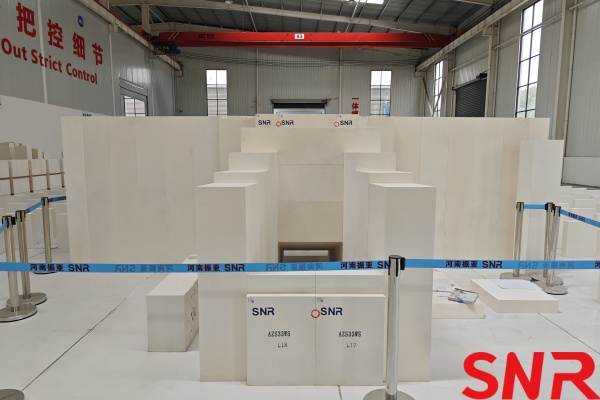
Fused cast refractories provide several key advantages compared with conventional sintered products.
5.1 Superior Corrosion Resistance
The dense glassy phase and interlocking crystal structure of fused cast materials significantly improve resistance to molten glass attack. The absence of open porosity means that molten glass cannot easily penetrate into the refractory bulk, which is a common failure mode for sintered products.
5.2 Low Porosity
Lower porosity reduces glass penetration and minimizes contamination. Fused cast refractories typically have apparent porosities below 2%, compared to 12–18% for high-quality sintered materials. This near-zero porosity is a key reason for their excellent performance in critical glass furnace zones.
5.3 Longer glass furnace Life
Using high-quality fused cast refractories can extend glass furnace campaign life by several years, reducing maintenance frequency and shutdown costs. A typical container glass furnace using fused cast AZS sidewalls can now achieve campaign lives of 10 to 12 years, compared to 6 to 8 years with sintered products.
5.4 Improved Glass Quality
Stable refractory performance reduces defects such as stones, cords, and inclusions in finished glass products. Because fused cast materials do not shed particles easily and have low glass-phase exudation, the risk of refractory-related defects is significantly lower than with sintered alternatives.
6. Refractory Selection for Different Glass Types
Different glass products require different glass furnace operating conditions and refractory solutions.
6.1 Container Glass
Container glass furnaces prioritize long campaign life and stable production. AZS sidewall blocks are commonly used, with AZS-36 being the standard grade for most applications. For larger glass furnaces or those producing flint glass (which has higher quality requirements), AZS-41 may be used in the most critical wear zones.
6.2 Float Glass
Float glass requires excellent glass homogeneity and minimal defects. High-quality fused cast materials are essential for maintaining stable production. In addition to AZS sidewalls, float glass furnaces often use fused cast alumina crowns, especially in oxy-fuel designs, to prevent alkali corrosion and maintain optical quality.
6.3 Photovoltaic Glass
Photovoltaic glass production often involves high pulling rates and large glass furnace capacities. This creates greater thermal and corrosion stress on refractories. Many photovoltaic glass furnaces now operate at over 1000 tons per day, with some exceeding 1500 tons per day. In these extreme conditions, AZS-41 is the standard choice for all glass-contact zones.
6.4 Electronic Glass
Electronic glass requires extremely low contamination levels. Special fused cast zirconia products are often selected to reduce glass defects. In display glass furnaces, even sub-ppm levels of certain elements can cause defects in the final product. Therefore, high-purity fused cast refractories with carefully controlled trace element levels are essential.
7. Installation and Maintenance of Fused Cast Refractories
Even the highest-quality refractory materials cannot perform well without proper installation and maintenance.
7.1 Precise Masonry
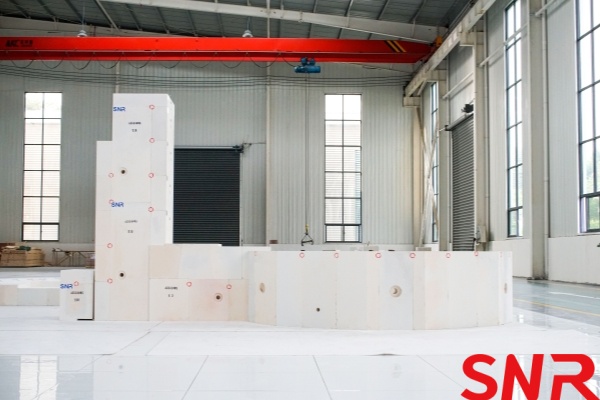
Proper joint design and accurate brick alignment are essential to avoid stress concentration and glass leakage. In modern glass furnace construction, laser alignment tools are used to ensure that each block is placed within tight tolerances. Joint thickness is typically kept below 1 millimeter for critical areas, and specialty mortars with compositions matched to the refractory are used.
7.2 Controlled Heat-Up
The glass furnace heating schedule must be carefully controlled to minimize thermal shock. Most fused cast refractories require heat-up rates of less than 10°C per hour in critical temperature ranges, especially between 200°C and 600°C where phase transformations occur. Computer-controlled heating systems are now standard to ensure compliance with manufacturer specifications.
7.3 Regular Inspection
Periodic monitoring of refractory wear, glass furnace pressure, and glass quality helps identify problems before major damage occurs. Visual inspection through observation ports, combined with thermal imaging and laser profiling, allows operators to track refractory thickness loss over time.
7.4 Hot Repair Technology
Modern ceramic welding and hot repair technologies allow local glass furnace repairs without complete shutdown. These technologies use specialized equipment to deposit refractory material onto worn areas while the glass furnace remains at operating temperature. This significantly reduces production losses and can extend glass furnace campaign life by several years.
8. Future Development Trends
The glass industry is moving toward higher efficiency, lower emissions, and smarter manufacturing systems. These trends are creating new challenges and opportunities for refractory manufacturers.
In recent years, the rapid expansion of photovoltaic glass production and electronic display glass manufacturing has significantly increased technical requirements for refractory materials. Modern glass furnaces are becoming larger, hotter, and more energy-efficient. Some ultra-large photovoltaic glass furnaces now exceed 1500 tons per day, placing enormous stress on glass furnace structures.
Under these conditions, refractory materials must not only resist corrosion but also maintain dimensional stability over long operating campaigns.
8.1 Longer glass furnace Campaign Life
Glass producers increasingly demand glass furnace campaign lives exceeding 12 to 15 years. This requires refractory materials with even higher corrosion resistance and structural reliability. Research is ongoing into new AZS compositions with zirconia contents above 45%, as well as into alternative oxide systems such as alumina-chromia and alumina-yttria.
8.2 Energy Efficiency and Low Carbon Production
Electric boosting, oxy-fuel combustion, and hybrid heating systems are becoming more common. These technologies impose new thermal and chemical conditions on refractories.
For example, oxy-fuel glass furnaces reduce nitrogen content in combustion gases, increasing flame temperature and changing alkali vapor distribution inside the glass furnace. As a result, refractory materials must adapt to higher localized temperatures and different corrosion environments. Fusion-cast alumina and zirconia products are increasingly specified for oxy-fuel glass furnace crowns and sidewalls.
8.3 Digital glass furnace Monitoring
Advanced sensors and AI-based monitoring systems can track refractory wear and glass furnace conditions in real time. This helps optimize maintenance schedules and extend glass furnace lifespan.
Some modern glass furnaces already use infrared thermal imaging systems to monitor crown temperature distribution and identify abnormal hot spots before structural damage occurs. Others use acoustic emission sensors to detect crack formation in critical refractory blocks.
8.4 Sustainable Refractory Manufacturing
Refractory manufacturers are also focusing on reducing energy consumption and carbon emissions during production. Recycling refractory waste and improving raw material utilization are becoming important development directions.
Some manufacturers are developing low-carbon electric melting technologies and cleaner casting processes to reduce environmental impact. At the same time, research into nano-structured refractory materials and optimized crystal phase distribution is expected to further improve refractory performance in future high-capacity glass furnaces.
8.5 Advanced Corrosion-Resistant Coating Technologies
In addition to bulk refractory development, coating technologies are emerging as a complementary solution to extend the service life of fused cast refractories. Protective coatings applied to the hot face of refractory blocks can act as sacrificial barriers, reducing direct contact between molten glass or alkali vapors and the base material.
Several coating systems are currently under investigation. High-zirconia slurries, for example, can be sprayed onto AZS sidewalls during glass furnace operation using robotic thermal spray equipment. These coatings form a dense protective layer that resists glass penetration and can be reapplied during scheduled maintenance outages. Another promising approach involves the use of rare-earth oxide coatings, such as yttria-stabilized zirconia, which offer exceptional chemical stability in aggressive glass environments.
Field trials in container glass furnaces have shown that properly applied coatings can reduce the corrosion rate of AZS-36 sidewall blocks by up to 30%, potentially adding one to two years of glass furnace campaign life. However, challenges remain in achieving consistent coating adhesion and matching thermal expansion properties between the coating and the substrate. Future research will focus on developing multi-layer coating systems and in-situ repair techniques that can be applied without cooling the glass furnace.
8.6 Hybrid Refractory Structures
Another emerging trend is the design of hybrid refractory structures, where different grades of fused cast materials are combined within a single glass furnace zone to optimize both performance and cost. For example, a sidewall block may have a high-zirconia (AZS-41) hot face directly cast against a lower-cost AZS-33 backing layer. During the electrofusion process, these two compositions form a metallurgical bond, eliminating the need for mortar joints between different grades.
This approach offers several advantages. The high-zirconia layer provides maximum corrosion resistance where it is needed most, while the lower-grade backing provides structural support at reduced material cost. Hybrid blocks also reduce the overall weight of critical glass furnace sections and improve thermal insulation characteristics. Early adopters of this technology in European photovoltaic glass furnaces have reported a 15% reduction in sidewall replacement frequency compared to conventional monolithic AZS-41 blocks.
8.7 Recycling and Circular Economy for Fused Cast Refractories
As sustainability becomes a central concern for the glass industry, the recycling of spent fused cast refractories is gaining attention. Unlike sintered refractories, which often have high open porosity and can be heavily contaminated with glass, fused cast materials have very low porosity and can sometimes be reclaimed and reprocessed.
Several refractory manufacturers have established take-back programs for used AZS blocks. After removal from decommissioned glass furnaces, these blocks are crushed, sorted, and re-melted in electric arc glass furnaces to produce new fused cast products. Current recycling rates for AZS materials are still low, typically below 15%, due to challenges in separating residual glass and ensuring consistent chemistry. However, ongoing research into advanced sorting technologies — including laser-induced breakdown spectroscopy (LIBS) and X-ray fluorescence (XRF) sorting — is expected to increase recycling rates to 40% or higher within the next decade.
Conclusion
glass furnaces operate under some of the harshest industrial conditions, involving extreme temperatures, aggressive chemical environments, and continuous operation over many years. Under these demanding conditions, refractory materials are not simply construction materials; they are essential components that directly influence glass furnace performance, energy efficiency, product quality, and operational stability.
Among all refractory products used in the glass industry, fused cast refractories — especially fused cast AZS blocks — have become the cornerstone of modern glass furnace construction. Their superior resistance to molten glass corrosion, low porosity, high structural strength, and long service life make them indispensable in critical glass furnace zones.
As the glass industry continues to pursue larger glass furnace capacities, cleaner energy technologies, higher product quality, and lower carbon emissions, the role of advanced refractory technology will become even more important. Future refractory development will focus not only on durability and corrosion resistance, but also on intelligent monitoring, sustainable manufacturing, and compatibility with emerging glass furnace technologies.
For refractory manufacturers and glass producers alike, close cooperation in material research, glass furnace design, installation technology, and operational management will be essential for achieving longer glass furnace campaigns and more sustainable glass production.
Ultimately, the development of high-performance fused cast refractories will continue to shape the future of modern glass manufacturing.
 I am Zoe. If you have any purchasing plans for fused cast AZS refractory blocks, please contact me.
[email protected]/ WhatsApp:+86 15670323812


 +86-18203976036