

This paper systematically describes the development history of low-exudation fused cast AZS (Alumina-Zirconia-Silica) refractories, and discusses in detail their physico-chemical properties, microstructural characteristics, and core applications in glass furnaces. Owing to the significant reduction in glass-phase exudation, the contamination of molten glass by these blocks is greatly diminished, and the glass furnace campaign life is effectively prolonged, meeting the new requirements of modern glass furnaces toward larger scale and higher quality. Through formulation optimisation, process control, and exudation mechanism analysis, this work provides a highly reliable refractory solution for the glass industry.
1. Introduction
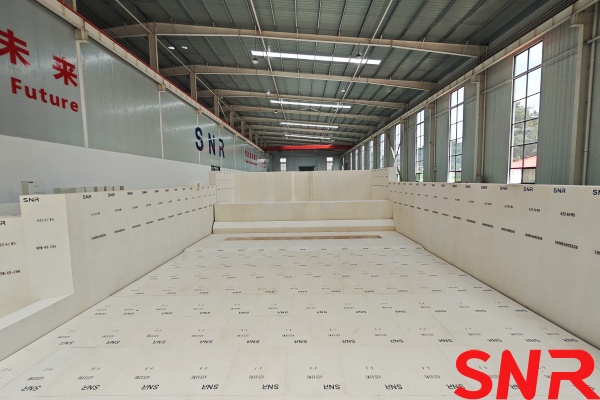
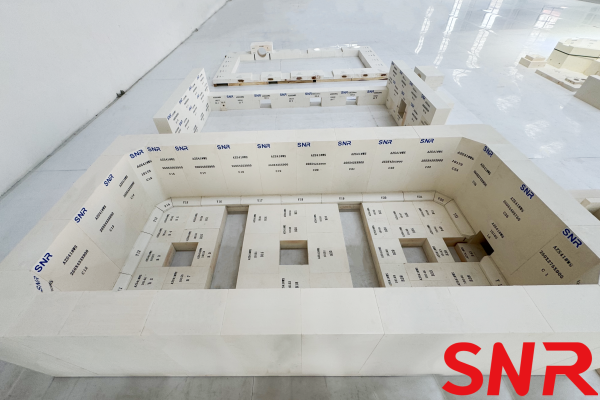
Fused cast AZS refractories represent a critical branch in the family of refractories used in glass furnaces. With their excellent resistance to molten glass corrosion and extremely low tendency to contaminate the glass melt, they are widely applied in various types of glass furnaces – from float glass, container glass, to electronic glass and photovoltaic glass – as key refractories in direct contact with molten glass. Their quality and performance directly determine the final glass product quality and the operational efficiency of the glass furnace.
In recent years, with the rapid evolution of the glass industry, glass furnaces have shown a marked trend toward large-scale units, with daily melting and output capacities continuously increasing, and melting and fining temperatures being raised. At the same time, the market demands increasingly stringent quality standards for glass products. For example, leading international float glass specifications require that the number of micro-defects (< 0.3 mm) per square metre of glass must be below 2–3. These developments lead to higher flame-space temperatures in the glass furnace, imposing more severe performance requirements on fused cast AZS blocks used in the superstructure (crown, breastwalls, ports, etc.). In particular, the glass-phase exudation behaviour has become a key indicator for evaluating the high-temperature service performance of these materials.
2. Service Characteristics of Fused Cast AZS Blocks
Fused cast AZS blocks are produced by high-temperature oxidative melting, casting, and subsequent controlled annealing. The solidification and hardening of the melt are essentially the formation process of crystalline phases within the block. During cooling, ZrO₂ and Al₂O₃ precipitate successively, forming baddeleyite and corundum crystalline phases. These two phases form a dense eutectic interlocking structure, constituting the skeletal framework of fused cast AZS blocks. SiO₂ and Na₂O form the glass phase, which solidifies by dissolving impurities such as Fe₂O₃ and TiO₂ during cooling, and fills the interstices of the eutectic skeleton. As a result, fused cast AZS blocks exhibit well-developed crystals, dense microstructure, and low porosity, endowing them with excellent high-temperature mechanical properties and corrosion resistance.
Conventional fused cast AZS blocks are generally classified into three grades according to ZrO₂ content, and their representative physico-chemical properties are shown in Table 1. It can be seen from Table 1 that with increasing ZrO₂ content, SiO₂ content decreases correspondingly, and the glass-phase exudation level is maintained at about 2.5%–3.0% (1500°C × 4 h). During high-temperature service, the glass phase exudes from the block and undergoes exchange reactions with the molten glass, accelerating the corrosion of crystalline phases. Therefore, the glass-phase exudation behaviour directly affects the corrosion resistance of the material and the final quality of the glass product.
|
Table 1 Physico-chemical properties of three fused cast AZS grades with different ZrO₂ contents / % |
|||||
|
Grade |
ZrO₂ |
SiO₂ |
Fe₂O₃+TiO₂ |
Al₂O₃ |
Glass exudation (1500°C·4h) |
|
AZS 33 |
33 |
15 |
0.25 |
50.4 |
2.5 |
|
AZS 36 |
36 |
14 |
0.25 |
48.4 |
3.0 |
|
AZS 41 |
41 |
12 |
0.25 |
44.6 |
3.0 |
Glass-phase exudation not only affects the structural stability of the block itself, but also leads to the formation of Al₂O₃-rich and ZrO₂-rich nodules and stones on the block surface. Once these exudates spall off and enter the molten glass, they cause defects such as cords and bubbles, seriously compromising glass quality. Therefore, reducing glass-phase exudation is an important research direction for enhancing the service performance of fused cast AZS blocks.
3. Wear Mechanisms in the Glass Furnace Superstructure
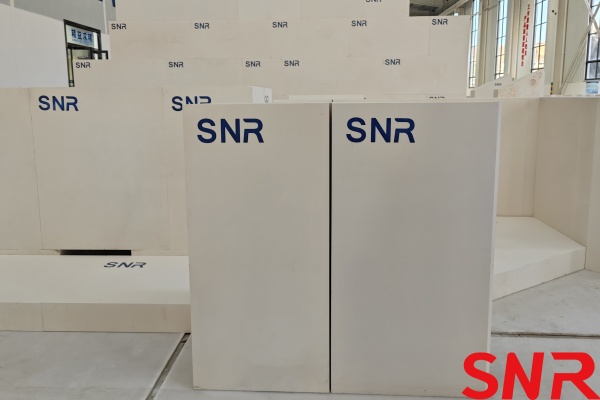
The superstructure of glass furnaces (including the crown, breastwalls, port lips, etc.) undertakes critical functions such as heat transfer from the combustion flame, glass furnace pressure balance, and exhaust gas removal. To reduce heat losses, modern glass furnaces are usually insulated on the superstructure, which further raises the ambient temperature in these zones. Moreover, when converting from air-fuel combustion to oxy-fuel combustion, the atmosphere composition in the superstructure changes dramatically: the volume concentration of water vapour increases by about 3 times, and the concentration of alkali volatiles rises by 3–6 times. Under the synergistic effects of high temperature, high water vapour, and high alkali volatile concentrations, the corrosion of refractories is significantly intensified.
The wear of fused cast AZS blocks in the superstructure mainly manifests in two forms: (1) glass-phase exudation, and (2) chemical attack by batch carryover and alkali/borate volatiles. Although the mechanisms differ, they often interact and reinforce each other: glass-phase exudation provides diffusion paths for corrosive media, while corrosion products further promote exudation, forming a vicious circle. When the amount of exuded glass phase exceeds a critical value, severe nodulation and drips appear on the block surface, eventually becoming the source of glass defects that directly affect the yield of the glass production line.
For fused cast AZS blocks used in the superstructure, it is essential to possess excellent thermal shock resistance, resistance to batch attack, and extremely low glass-phase exudation tendency. This requires comprehensive control of chemical composition, microstructure, and manufacturing processes during material development.
4. Development of Low-Exudation Fused Cast AZS Blocks
4.1 Design Concept and Formulation Optimisation
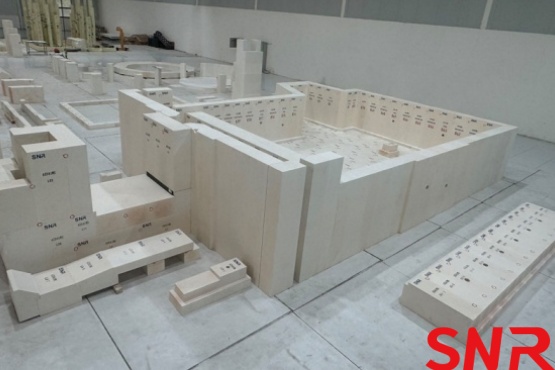
The core of developing low-exudation fused cast AZS blocks lies in reducing the glass-phase content and suppressing its exudation kinetics at high temperatures. In the fused cast AZS system, SiO₂ and Na₂O are the main glass-formers, and their content directly determines the total glass-phase amount. Lowering SiO₂ and Na₂O effectively reduces the glass-phase matrix and thus reduces the potential exudation. Furthermore, impurities such as Fe₂O₃ and TiO₂, as well as carbon contamination introduced from graphite electrodes and resin bonded sand moulds during melting, can promote glass exudation through oxidation reactions at high temperatures. Therefore, the raw material formulation must be designed to strictly control impurity introduction and optimise the melting process to minimise carbon contamination.
Based on these principles, an experimental formulation for low-exudation fused cast AZS blocks was designed (see Table 2). This formulation controls ZrO₂ at 33%–34%, reduces SiO₂ to 10%–12%, Na₂O to 1.0%–1.2%, and the sum of Fe₂O₃+TiO₂ to below 0.20%, with the balance being Al₂O₃. This composition remains within the eutectic region of the Al₂O₃-ZrO₂-SiO₂ ternary phase diagram, but the glass-former content is significantly lower than that of conventional grades, providing a compositional basis for low exudation.
|
Table 2 Experimental formulation of low-exudation fused cast AZS block / % |
|||||
|
Component |
ZrO₂ |
SiO₂ |
Na₂O |
Fe₂O₃+TiO₂ |
Al₂O₃ |
|
Content |
33–34 |
10–12 |
1.0–1.2 |
≤0.20 |
Balance |
4.2 Pilot-Scale Trial Production and Performance Verification
Within the designed formulation ranges, various batch compositions were prepared and trial-cast in an industrial electric melting glass furnace. During melting, strict control was exercised over melting temperature, casting speed, and annealing schedule to minimise electrode carburisation and sand mould contamination. After demoulding, test blocks were sampled for chemical composition and glass-phase exudation (1500°C × 4 h) measurements; the results are shown in Table 3. As can be seen, the trial block contained 33.5% ZrO₂, 11.0% SiO₂, 1.05% Na₂O, and 0.14% (Fe₂O₃+TiO₂), with a glass exudation of only 1.35%, far below the 2.5% level of the conventional AZS 33 grade.
|
Table 3 Analytical results of pilot-scale trial cast blocks / % |
|||||
|
ZrO₂ |
SiO₂ |
Na₂O |
Fe₂O₃+TiO₂ |
Al₂O₃ |
Glass exudation (1500°C·4h) |
|
33.5 |
11.0 |
1.05 |
0.14 |
Balance |
1.35 |
Microstructural observation revealed that the low-exudation blocks exhibit a more continuous crystalline skeleton, with baddeleyite–corundum eutectic intergrowth being tightly interlocked. The glass phase is distributed as isolated islands at grain boundaries, a structure that significantly suppresses the migration and exudation of the glass phase at high temperatures. In addition, because the glass-phase content is reduced, the diffusion path for alkali/borate volatiles into the block interior is obstructed, effectively retarding the chemical attack rate.
4.3 Key Process Control Points
To achieve stable low-exudation performance, in addition to formulation design, the production process must strictly control the following aspects:
① Raw material purity: select high-purity zircon sand, industrial alumina, and soda ash with low impurity levels to avoid harmful Fe₂O₃ and TiO₂;
② Melting process: adopt oxy-fuel assisted electric melting to reduce graphite electrode consumption, and optimise the melting temperature profile to minimise carbon contamination;
③ Casting and annealing: use bottom-pour casting to reduce turbulent gas entrapment, and employ stepwise controlled cooling during annealing to avoid stress cracking and promote uniform glass-phase distribution. These measures ensure batch-to-batch consistency of the low-exudation blocks.
5. Application Results and Prospects
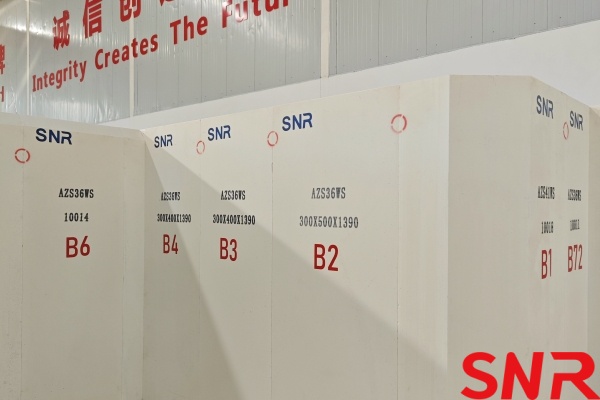
Low-exudation fused cast AZS blocks have been industrially applied in the superstructure of float glass, electronic glass, and photovoltaic glass furnaces. Actual service data indicate that, compared with conventional AZS 33 blocks, after two glass furnace campaigns (approximately 6–8 years), the residual thickness of the low-exudation blocks increases by 15%–20%, surface nodulation and drips are reduced by about 60%, and the incidence of glass defects (stones, cords) decreases significantly. Especially in oxy-fuel glass furnaces, where water vapour and alkali concentrations are higher, the advantages of low-exudation blocks are more pronounced, effectively extending the hot-repair interval and overall glass furnace campaign life.
Furthermore, assessments of the impact on molten glass quality show that the migration of Na₂O and SiO₂ from the glass phase is markedly reduced, effectively avoiding local compositional fluctuations in the glass melt. This is particularly beneficial for the melting of specialty glasses such as high-alumina and borosilicate glasses. As glass products evolve toward ultra-thin, high-transmittance, and high-strength varieties, low-exudation fused cast AZS blocks will become indispensable key materials for high-end glass furnaces.
6. Conclusions
(1) The wear of fused cast AZS blocks in the glass furnace superstructure is dominated by glass-phase exudation and alkali/borate volatile attack, with significant synergistic effects; reducing glass-phase exudation is the core approach to extending service life.
(2) By optimising the formulation to lower SiO₂ and Na₂O contents, and strictly controlling Fe₂O₃, TiO₂ impurities and carbon contamination, low-exudation fused cast AZS blocks with glass-phase exudation (1500°C × 4 h) below 1.5% can be produced, representing a reduction of more than 40% compared with conventional products.
(3) The low-exudation blocks possess a denser crystalline skeleton and more stable glass-phase distribution. In practical glass furnace applications, they significantly reduce nodulation, drips, and glass defects, prolong glass furnace maintenance intervals, and improve glass quality.
(4) With continuous increases in quality and environmental requirements in the glass industry, low-exudation fused cast AZS blocks show broad application prospects in large-scale, oxy-fuel, and specialty-glass furnaces, and represent an important direction for refractory technology development.
Glass-phase exudation is essentially a thermally activated process controlled by temperature, time, atmosphere, and the composition of the glass phase. In fused cast AZS blocks, the glass phase is rich in SiO₂, Na₂O, and minor CaO, FeO, etc., and its viscosity decreases sharply with increasing temperature. When the block surface temperature exceeds 1300°C, the glass viscosity drops below 10⁴–10⁵ Pa·s, driving migration toward the surface under surface tension and concentration gradients. In oxy-fuel atmospheres, the elevated water vapour partial pressure accelerates the migration of Na⁺ in the glass phase and promotes the depolymerisation of the silicate network, thereby lowering the activation energy for exudation. Therefore, by reducing the total glass-phase amount and adjusting its chemical composition (e.g., increasing the Al₂O₃/SiO₂ ratio), the low-exudation blocks effectively increase the high-temperature viscosity of the glass phase, thus suppressing the exudation rate.
Moreover, the continuity of the crystalline skeleton plays a physical hindrance to glass-phase exudation. In low-exudation blocks, the eutectic skeleton is more developed and the grain size is more uniform, creating a more tortuous diffusion path, which further reduces the exudation tendency from a kinetic standpoint. In the future, doping with trace rare-earth oxides (such as Y₂O₃, CeO₂) to modify the glass-phase structure and further enhance its high-temperature stability will be an important direction for subsequent research.
 I am Zoe. If you have any purchasing plans for fused cast AZS refractory blocks, please contact me.
[email protected]/ WhatsApp:+86 15670323812


 +86-18203976036