

Introduction
Glass furnaces are among the most demanding environments in the entire refractory industry. Whether the installation is a float glass line, a container glass furnace, a photovoltaic (solar) glass melting furnace, or a special-glass tank, the melting end must sustain continuous operating temperatures of 1450 to 1600 °C, an atmosphere saturated with alkali vapour (sodium and potassium oxides) and water vapour, intimate contact between the refractory and aggressive molten glass, and the mechanical and thermal stresses of a multi-year campaign. Few materials survive this combination, and the electro fused AZS series has become the default refractory for the glass-contact and load-bearing zones of virtually every modern glass furnace.
The lining is not a passive shell. Its selection directly determines campaign length, the frequency of unscheduled hot repairs, energy consumption, and—critically—the quality of the glass itself, because any refractory degradation can introduce stones, knots, blisters, or seeds into the melt. Getting the specification right is therefore both a technical and an economic decision.
This article provides a practical framework rather than a theoretical treatise. It explains what a fused cast AZS block is, how the three grades (AZS 33, 36, and 41) differ, why the casting method (regular cast, quasi-void-free, and void-free) matters as much as the grade, how blocks should be assigned zone by zone in a glass furnace, which quality parameters a buyer must verify, and which specification mistakes are most commonly made.
The widespread adoption of fused cast AZS in glass furnaces followed the mid-twentieth-century recognition that silica and fireclay refractories could not deliver the campaign lengths and glass purity demanded by modern continuous melting. Today a typical glass furnace contains hundreds to thousands of individually specified blocks, and the cost of the refractory lining—while significant—is small relative to the value of the glass produced over a multi-year campaign and the cost of an unscheduled shutdown. This economic logic is precisely why correct specification pays for itself many times over.
Beyond campaign length, the refractory also governs glass quality. A block that sheds grains or exudes glass phase introduces stones, knots, or seeds; an eroded joint can release bubbles into the melt. Because glass defects are far more costly to a producer than the refractory itself, specifying for defect prevention—especially low-exudation crown and superstructure blocks—is as important as specifying for corrosion.
1. What Is a Fused Cast AZS Block?
Fused cast AZS belongs to the Al2O3–ZrO2–SiO2 (AZS) refractory system. The letters stand for Alumina, Zirconia, and Silica—the three oxides that define its composition. The material is produced by electrically fusing a precisely proportioned batch of alumina, zircon, and silica raw materials in an electric-arc or electric-resistance furnace at temperatures around 1900 to 2000 °C, until a fully liquid, homogeneous melt is obtained.
The molten AZS is then poured (cast) into sand or graphite moulds and allowed to solidify under controlled conditions, followed by a slow, programmed cooling known as annealing, which relieves the severe internal stresses generated during solidification. The finished product is a dense, essentially non-porous ceramic whose crystalline phases are corundum (Al2O3) and baddeleyite or zirconia (ZrO2), bound by a small amount of aluminosilicate glass phase.
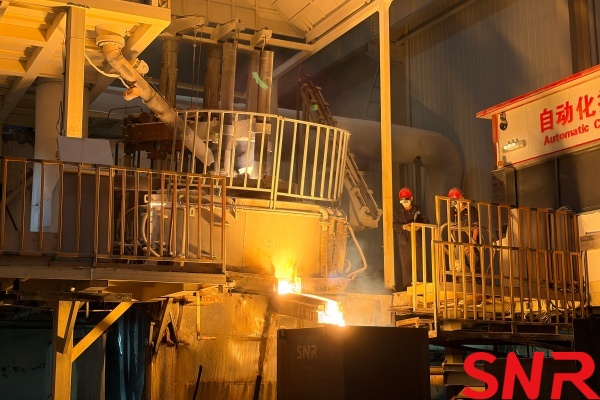
The fusion route is what gives fused cast AZS its advantage. Because the raw materials are melted completely, there is no residual pore network from binder burnout or incomplete densification, and the crystalline phases grow directly from the melt into a continuous, interlocked structure. This is fundamentally different from a bonded refractory, where grains are held together by a fired bond and the pores between them remain. The practical consequence is far lower permeability and far higher corrosion resistance at the glass-contact face.
Because the material is fused rather than simply sintered, it has a homogeneous, fully dense structure with bulk density typically above 3.4 g/cm3 (and above 3.9 g/cm3 for AZS 41), extremely low permeability, and outstanding resistance to molten-glass corrosion and alkali-vapour attack. These properties are exactly what the glass-contact face of a glass furnace requires.
The small glass phase that binds the crystals is the weakest link of any fused cast AZS block. Under service temperature the glass phase can soften and ‘exude‘ (bleed) from the block surface; if this happens above the glass line in the crown or superstructure, the exuded material drips into the melt and becomes a glass defect. Low-exudation grades reduce the glass-phase content and its mobility, which is why exudation class is a specified property for crown and superstructure blocks rather than an optional extra.
It is essential to distinguish the fused cast AZS block from the bonded (sintered) AZS product. Bonded AZS is a pressed-and-fired refractory with approximately 30% ZrO2, a porous microstructure, a bulk density near 3.2 g/cm3, and—importantly—much better thermal-shock resistance but markedly lower corrosion resistance. The two products are not interchangeable. A bonded AZS block must never be specified as a direct substitute for a fused cast AZS block in glass-contact service, because the density, corrosion behaviour, and manufacturing route are fundamentally different; doing so quietly shortens the campaign.
2. Grades: AZS 33, AZS 36, and AZS 41
The three mainstream grades are defined by their zirconia content. AZS 33 contains about 32 to 34% ZrO2, AZS 36 about 35 to 37% ZrO2, and AZS 41 about 40 to 42% ZrO2. In the international nomenclature these correspond approximately to ER 1681, ER 1685, and ER 1711 respectively.
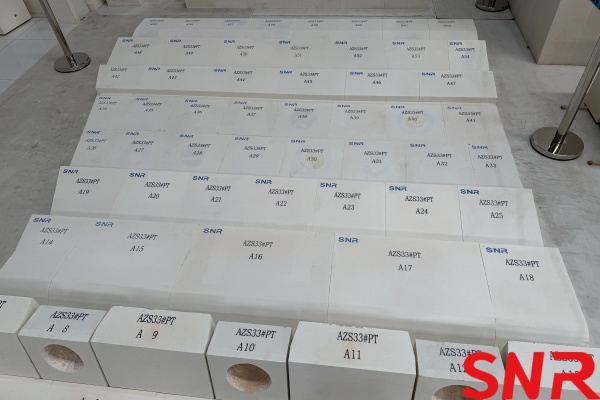
As zirconia content increases, both corrosion resistance and cost rise. AZS 33 is the economical workhorse, used in lower-duty zones and much of the upper structure where corrosion is moderate. AZS 36 is a balanced choice for sidewalls and paving where the corrosion load is more significant. AZS 41 is reserved for the most severe glass-contact positions—the tank-wall liquid line, the throat, and the paving—where maximum corrosion resistance is required to protect a long campaign.
From a life-cycle view, the grade decision is rarely about the block price alone. A modest increase in grade at a single severe location can add years to the campaign and avoid a costly hot repair, whereas spreading the top grade uniformly across mild zones only inflates the bill. The disciplined engineer therefore optimises grade by zone, not by habit.
A frequent misconception is that ‘a higher grade is always better.‘ In practice the grade should be matched to the local duty. Over-specifying AZS 41 in mild zones adds cost without extending the campaign, while under-specifying in a severe zone sacrifices campaign life. The correct approach is zonal, not uniform.
3. Casting Methods and Shrinkage Cavities
Like all fused cast products, an AZS block shrinks as it solidifies, and this contraction leaves a shrinkage cavity (often called a void or a riser cavity) in the upper part of the casting. The position of this cavity and the way it is treated define the casting method—and this is one of the most misunderstood topics in the industry.
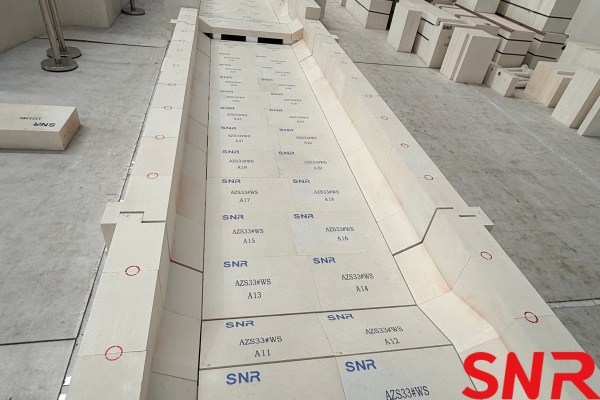
In regular cast (coded PT, i.e. ordinary casting), the shrinkage cavity is permitted to remain inside the block body. The block is perfectly sound for non-critical and non-load-bearing zones, provided the cavity does not fall on a glass-contact or loaded face. In void-free cast (coded WS), the cavity is concentrated at one end, that end is cut off and discarded, and the delivered block is essentially free of internal voids along its full length—this is mandatory for tuckstones, skewbacks, and other load-bearing or glass-contact members, where a cavity would become an initiation point for joint erosion. An intermediate grade (ZWS, quasi-void-free) concentrates the cavity at the bottom and removes part of it. In some supplier coding systems the void-free grade appears as RT or similar; regardless of the label, it denotes a block from which the shrinkage zone has been removed.
A point that every reputable supplier should state openly: the cut-off portion is not charged to the customer. A fused cast AZS block is priced by its net finished (delivered) weight, and the scrap removed at the riser and shrinkage zone is borne by the manufacturer. Any claim that ‘you are paying for the wasted cut-off‘ is incorrect and should be treated as a red flag.
Controlled annealing (slow cooling) is standard practice for every genuine fused-cast producer. It is not a special feature and should not be marketed as one. Its real, practical value is as a discriminator: a true manufacturer anneals every block as a matter of course, whereas a trading company that merely resells blocks cannot show you an annealing curve or a controlled cooling process. Asking to see the annealing practice is a quick way to tell a producer from a reseller.
Physically, void-free casting is achieved with a deliberately oversized riser and continuous feeding of molten material into the mould as solidification proceeds, so that the contraction is accommodated entirely within the riser zone. Once the block is fully solid, the riser—together with the concentrated cavity it contains—is cut away and the remaining block is verified. This is why a genuine WS block costs more: the manufacturer invests extra melt and loses yield to guarantee a void-free delivered length.
The value of the void-free grade comes from the process investment it requires—additional riser material, feeding, and the loss of the cut-off portion—not from the discarded scrap itself. Specifying WS where a cavity would be dangerous is not ‘paying for waste‘; it is buying freedom from a premature failure.
4. Corrosion Mechanisms in a Glass Furnace
To specify fused cast AZS correctly, it helps to understand how a glass furnace actually destroys its lining. The dominant mechanisms are different above and below the glass line.
Below the glass line, the primary attack is dissolution of the refractory into the molten glass, accelerated at the flux (glass) line where the refractory is attacked from both the molten glass below and the hot, alkali-rich vapour above. This produces the characteristic ‘upward drilling‘ corrosion at the liquid line of tank walls, which is why the liquid-line zone is specified at the highest grade (AZS 41-WS) and why thickness there matters most.
Above the glass line, in the crown, breast wall, and superstructure, the attack is mainly alkali-vapour (Na2O, K2O) condensation and reaction with the refractory surface, together with batch dust and temperature fluctuation. This is why the upper structure is often AZS 33-PT (regular cast) in the charging zone and electrofused α-β alumina after the hot spot, where glass-phase exudation (drip) from the AZS would contaminate the glass.
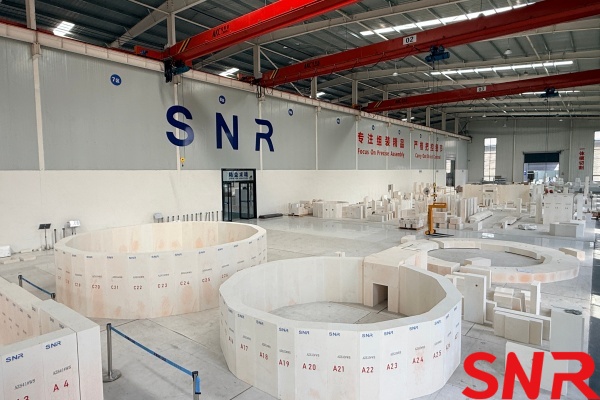
In the superstructure the damage is often cumulative and hidden: alkali vapour penetrates open joints, forms low-melting compounds, and slowly loosens the masonry. Tight, correctly specified joints and an appropriate joint configuration therefore protect the crown and breast wall as much as the block grade does, yet this is frequently overlooked when only the block specification is considered.
Two further mechanisms deserve attention. First, joint erosion: if a shrinkage cavity or a poorly fitted joint sits in a glass-contact zone, the melt preferentially attacks the joint and can undermine an otherwise sound block. Second, zirconia transformation and thermal shock: zirconia undergoes a crystalline transformation near 1000 °C that is accompanied by a volume change, and AZS bricks show anomalous expansion between 900 and 1200 °C; if the furnace tie rods are not adjusted during heating-up, local stress and cracking can result.
Quantitatively, the liquid-line corrosion rate of AZS in a soda-lime glass furnace is typically on the order of a few millimetres per year at the glass line, but it rises sharply with temperature, alkali concentration, and glass throughput. Designers therefore add a corrosion allowance to the liquid-line thickness and specify the highest grade there; a thin, low-grade sidewall at the liquid line is the most common cause of a campaign ending short of its target.
5. Zonal Application in the Glass Furnace
The guiding principle is consistent across all zones: place the highest-purity, most corrosion-resistant fused cast product at the glass-contact and load-bearing positions; use bonded or lower-grade products where the duty is milder; and specify electrofused α-β alumina wherever glass-phase exudation must be eliminated. The following assignments are typical for a large oxy-fuel or air-fired glass furnace.
Tank Wall (Sidewall)
The sidewall liquid line is the most severely corroded location in the furnace. AZS 41-WS is normally used at and just below the glass line, with AZS 33 or 36 lower in the wall where corrosion is gentler. The block must be void-free at the liquid line; a regular-cast block here would fail early. Because the liquid-line corrosion is localized, many furnaces protect the critical band with a thicker ‘lamella‘ or a higher-grade inset rather than thickening the entire wall, which saves cost while concentrating protection where it is needed. The inset still must be void-free, since any cavity at the liquid line defeats the purpose.
Paving (Tank Bottom)
The tank bottom uses a fused cast AZS working (paving) layer—commonly AZS 33-WS or 36-WS—over a secondary layer of bonded AZS or fireclay. The bonded secondary layer is an economical corrosion buffer that protects the bottom without the cost of a full fused-cast build-up.
Throat
The throat is the narrow passage linking the melting end to the working end. It is specified at AZS 41-WS, and water-cooled jackets are placed at the liquid line because the local melt velocity is high and hot repair is extremely difficult. Front-end erosion control, not on-site replacement, is the design emphasis.
Breast Wall
The melting-end breast wall faces high temperature and alkali attack. AZS 33 or 36 is used, with careful attention to the anomalous expansion of AZS between 900 and 1200 °C during start-up, which requires timely adjustment of the tie rods.
Crown
In many glass furnaces the crown is AZS 33-PT (regular cast) in the charging and early zone, where it resists batch dust and temperature swings at lower cost, and electrofused α-β alumina after the hot spot, where drip purity is critical. The crown is the single most safety-critical structure in the furnace.
Tuckstone and Skewback
These load-bearing members carry the weight of the tank and the crown. They must be at least ZWS and preferably WS; regular cast is prohibited because a shrinkage cavity on the loaded face can initiate a fracture. This rule is non-negotiable for safe operation.
Barrier Wall
The barrier wall (dam or weir) is often built from bonded AZS or AZS to protect the bottom paving and to control melt flow between the melting and refining zones. Its duty is milder than the sidewall, so a bonded product is frequently appropriate.
Feeder and Distributor Channels
The feeder and distributor channels, together with orifice rings, typically use AZS 33 or 36, often with zircon or α-β alumina at the most exposed orifice positions where exudation must be avoided.
6. Key Quality Parameters and Verification
A glass-furnace campaign is only as reliable as the blocks that enter it. Before a shipment is accepted, the following parameters should be checked against the purchase specification.
►Chemical Composition
Verify ZrO2, Al2O3, SiO2, Fe2O3, and Na2O (the glass-phase content) by independent assay or supplier mill certificate. The glass-phase content in particular influences exudation and corrosion behaviour.
►Bulk Density and Apparent Porosity
Higher bulk density and lower apparent porosity correlate strongly with better corrosion resistance. These are quick, reproducible checks that should be performed on samples from each batch.
►Exudation
Exudation (glass-phase bleed) is measured by the standard exudation test and is especially critical for crown and superstructure blocks; low-exudation grades are required wherever drip would defect the glass.
►Internal Voids
For WS and ZWS blocks, the absence of internal voids in the delivered length must be confirmed by radiographic or sectioning inspection—never assumed. A cavity that escapes detection becomes a joint-erosion site in service.
►Dimensions and Flatness
Tight joints depend on accurate dimensions and flatness. Verify block dimensions and flatness against the drawing with gauges; excessive joint width accelerates joint erosion.
►Annealing and Internal Stress
Confirm that the block was properly annealed and is free of internal stress cracks, via the manufacturer‘s annealing certificate and, where needed, a visual or penetrant check on arrival.
For incoming inspection a documented sampling plan—for example checking density and dimensions on a fixed percentage of each batch and radiographing a sample of WS blocks—provides traceability and makes it easy to reject non-conforming lots before they reach the furnace. Retaining the mill certificate and a reference sample for the duration of the campaign is good practice.
7. Common Specification Mistakes
The following mistakes recur in real projects and each carries a concrete penalty.
►Specifying regular cast (PT) on load-bearing members such as tuckstones or skewbacks, where only ZWS or WS is safe—this risks fracture under load.
►Ignoring the liquid-line erosion rate when setting throat and sidewall thickness, leading to premature failure at the most critical location.
►Assuming bonded AZS can replace fused cast AZS one-for-one; the density, corrosion resistance, and structure differ fundamentally, and the substitution silently shortens the campaign.
►Confusing casting-method codes—for example treating RT as ‘tilt casting‘ rather than void-free. The code defines shrinkage-cavity treatment, not the pouring geometry.
►Selecting grade purely by price rather than by zonal duty, producing either wasted cost (over-specification) or lost campaign life (under-specification).
►Omitting the required casting-method code and exudation class from the purchase order, which lets a cheaper grade be substituted without obvious traceability.
►Failing to verify the casting-method code at incoming inspection, so that a regular-cast block quietly enters a load-bearing position where only WS was specified.
►Specifying the crown in fused cast AZS across its full length instead of using electrofused α-β alumina after the hot spot, which invites drip defects in the glass and wastes the corrosion margin where it is not needed.
8. Handling, Cutting, and Jointing in Practice
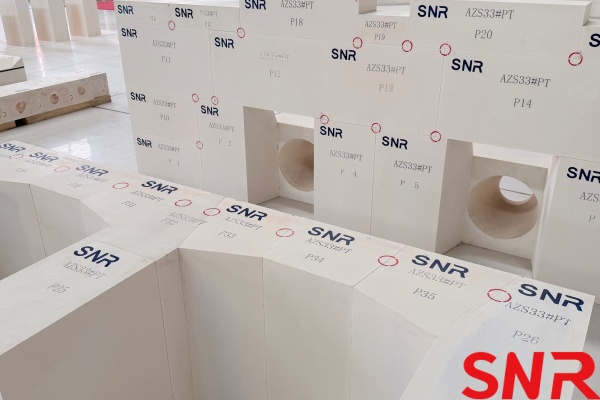
A fused cast AZS block leaves the manufacturer as a finished, annealed, essentially non-porous ceramic; whether that quality survives to the first melt depends largely on what happens during storage, cutting, and installation on site. Because the material is exceptionally hard and abrasive, all cutting and grinding must be carried out with diamond tooling under continuous water cooling. Dry or insufficiently cooled cutting generates localized surface heating that can induce thermal shock, surface micro-cracking, and spalling, while the zirconia- and alumina-rich dust produced is hazardous and must be controlled by wet collection and appropriate respiratory protection. In storage and handling the blocks are heavy and, despite their dense skin, vulnerable to edge chipping from impact; they should be lifted and stacked to avoid shock loading, kept dry, and protected from contamination by iron or organic debris that could later become a defect source at the glass-contact face.
►On-site Cutting and Shaping
Cutting to fit is sometimes unavoidable, but it must be disciplined. The cut face is rougher and more erosion-prone than the as-cast face, so shaping should be confined to non-glass-contact, non-load-bearing surfaces. Under no circumstances should material be removed from a loaded face of a tuckstone or skewback, and any cutting on these members must preserve the void-free soundness already verified at incoming inspection.
►Jointing and Dry Laying
Joint tightness is established long before the furnace is fired. As noted in the quality section, corrosion and alkali attack both accelerate through wide or poorly fitted joints, so block dimensions and flatness must be verified against the drawing and the crown and superstructure laid with minimal, dry joints. Vertical joints in adjacent courses should be staggered so that no continuous capillary path runs through the masonry; the crown itself is assembled as a single ring closed at the keystone. Glass-contact joints are kept as thin dry joints, or closed with a compatible zirconia-bearing jointing cement; organic or clay-rich mortars that would burn out and open a joint must be avoided in contact zones.
Good cutting and jointing practice does not improve the grade or the casting method, but it protects the corrosion margin those choices earned; poor practice quietly gives it back.
9. Commissioning, Heating-up, and Campaign Monitoring
Correct specification is necessary but not sufficient; the lining must also be brought into service correctly. After masonry is complete, the furnace is heated under a controlled, slow ramp. Fused cast AZS, together with the rest of the lining, must pass through the 900 to 1200 °C window in which AZS exhibits anomalous expansion without being mechanically constrained. Too steep a ramp creates thermal gradients that stress the masonry and can open joints or crack blocks. The ramp is typically held as a long, low-rate soak through the critical expansion band, with hold periods that let the entire structure equalize temperature before the next step.
►Tie-rod Adjustment and Crown Monitoring
During this heat-up the tie-rods on the breast walls and crown are deliberately loosened and re-tightened in steps so the structure can expand; neglecting this adjustment is a frequent cause of local overload, keystone or skewback distress, and early cracking. The crown is the most safety-critical element in the furnace, and its expansion is monitored continuously through heat-up and the campaign; any abnormal movement at the keystone or skewback is treated as a priority signal.
►Repair Strategy and End-of-campaign Assessment
Even with disciplined specification, local wear eventually appears, and the response strategy matters. At the liquid line and throat, front-end erosion control and planned hot repairs using fusion-cast inserts protect the campaign far better than repeated patch ramming, which only temporarily fills a cavity and cannot match AZS corrosion resistance. Patch mixes are a stopgap, not a substitute. Throughout the campaign, routine inspection — visual checks at the doghouse and hot spots, joint-width measurement, and, where feasible, thermal imaging of the superstructure — tracks the slow, cumulative loss of section that ultimately defines campaign end.
At the end of a campaign, residual sidewall and liquid-line thickness and the absence of through-cracks in the crown decide whether the crown can be carried into a second campaign — an important economic target introduced in the zonal section. The mill certificates, radiography records, and dimension checks accumulated at incoming inspection are what make that assessment and any warranty claim possible. In short, a long, low-cost campaign is the product of correct specification followed by disciplined commissioning and monitoring, not of the block alone.
Conclusion
Fused cast AZS blocks remain the backbone of glass-furnace refractories because no other material class combines their corrosion resistance, density, and structural integrity at the glass-contact face. A long campaign is not delivered by the block alone; it is the result of the correct combination of grade, casting method, zonal application, and verified quality. Engineers who match these variables to the actual furnace duty, and purchasers who verify the delivered block against the specification, consistently achieve lower life-cycle cost and fewer unscheduled hot repairs. As pull rates and furnace sizes continue to grow, the discipline of correct specification becomes only more decisive.
Looking ahead, the trend toward larger pull rates, thinner and purer glass, and tighter environmental limits on flue gas will keep fused cast AZS at the centre of glass-furnace design, while pushing further development of low-exudation grades, higher-zirconia compositions, and better understood casting methods. Purchasers and engineers who internalise the principles in this article will be well placed to specify with confidence as those demands evolve.
About SNR Refractory 
With extensive experience in the refractory industry and a strong focus on glass furnace applications, Henan SNR Refractory Co., Ltd. is committed to providing reliable refractory products and technical solutions for glass melting furnaces. Our product range covers a wide variety of refractory materials used in different glass furnace sections, including silica brick, fused cast AZS, alumina-based refractories, fireclay brick, high-alumina brick, magnesia brick, magnesia-alumina spinel brick, and other customised refractory products. We understand that refractory selection is closely related to glass furnace design, glass composition, operating temperature, corrosion conditions, and campaign objectives. Therefore, our approach is not limited to supplying individual refractory products. We aim to provide application-oriented refractory solutions, helping customers select suitable materials and grades according to their specific glass furnace conditions and technical requirements. For glass manufacturers, glass furnace contractors, engineering companies, and refractory distributors looking for reliable refractory materials or customised solutions for glass furnaces, Henan SNR Refractory Co., Ltd. is ready to provide technical consultation, product recommendations, quotations, and project support. If you have any requirements for glass furnace refractories, please feel free to contact us.

CONTACT: [email protected] / WhatsApp: +86 15670323812

 +86-18203976036
